Dahn Memory Lane: Pittsburgh’s Inclines
Pittsburgh is known for its inclines, some of which have had disastrous rides.

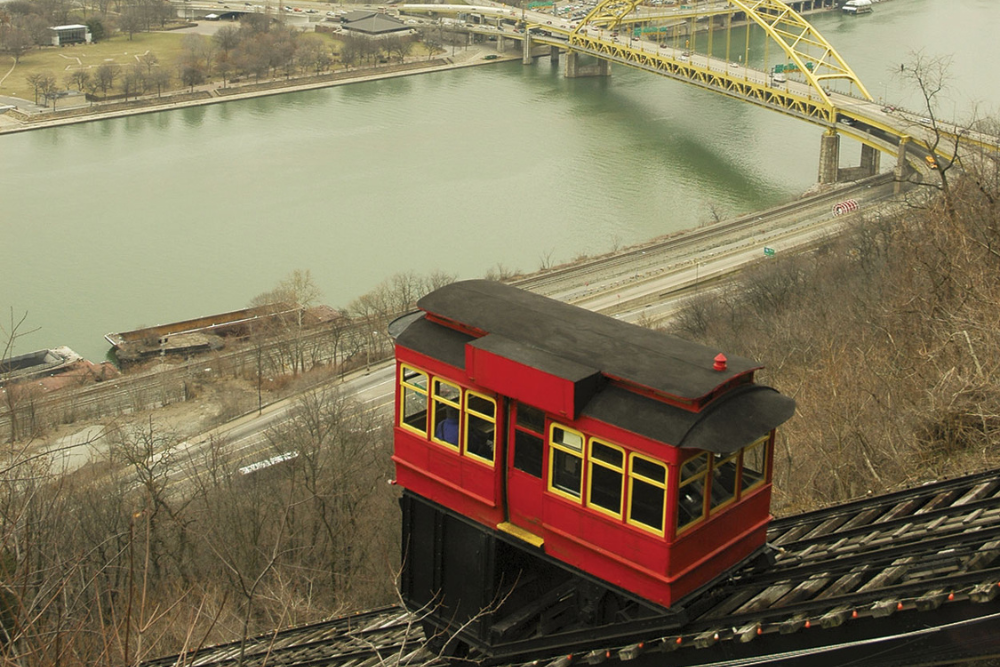
IN 1902, THE DUQUESNE INCLINE WAS UNEXPECTEDLY SHUT DOWN FOR REPAIRS — ON ELECTION DAY. PHOTO BY HUCK BEARD
I trust the incline.
Or at least, that’s what I reassuringly whisper each time I step into one of the cars belonging to our iconic hillside funiculars. “I trust the incline.” I trust it not to hurl me down the face of a steep hill that we long ago audaciously decided to call a mountain. I trust the doors to open when I get to the top or bottom. I trust the cables, if they exist, not to snap. I trust the brake to work. I trust that there is a brake? I trust the incline.
Not that I descend into a fit of panic each time I hop on for a ride. I genuinely enjoy the leisurely pace and the view once the car moves, but I still give myself (and the incline) a little be-brave-you-got-this pep talk. I trust you, incline.
As it turns out, there were moments across history when riders should not have been so trusting. Our inclines, most of which were long-ago demolished, have been the site of terrifying accidents and, yes, nightmare drops worthy of a scene in the next “Final Destination” installment.
I did not believe there had ever been an instance when one of our incline cars just snapped loose of its tethers to launch itself unfettered to destruction. I was wrong. It has happened several times.
One notable incident took place on June 17, 1885 at the Mt. Oliver incline, which stretched from today’s East Warrington Avenue in the South Side Slopes down to Freyburg Street in the Flats. At three o’clock in the afternoon, there was only one passenger along for the down trip — Mrs. Rosanna Donaldson. She was, from reports, enjoying the view as the car began its slow descent when, about halfway down, she noticed two repairmen on the track below her frantically waving their hats to Charley Longenbeck, the engineer in the upper station. Finally seeing their message, Charley lunged for his brake, but it was too late.
To his horror, the car carrying Rosanna reached the gap in the track the men had created as they swapped out a rail. He watched as it searched for its footing, found it absent and thus “toppled for a moment and then plunged off into space.” The car then performed a dramatic somersault into the ravine fifty feet below, strewing debris across the hillside for 300 feet. Remarkably, Rosanna was thrown from the car in such a manner that, as she recalled, “The next thing I remember I was standing on the hillside below with my umbrella and satchel gripped tightly in my hands, while a cloud of dust obscured everything.” She suffered only a bruise and a few slight cuts, but insisted she sensed “impending evil” upon entering the incline car.
Maybe she should have given it a pep talk.
A similar incident occurred at the ungodly hour of 3:15 a.m. on April 6, 1909 at the St. Clair Incline, which connected the Slopes at Salisbury Street with Josephine Street below. This accident wasn’t due to an ill-timed track repair, but was the result of the engineer, Jesse Briton, fainting at his post. He would later surmise that as he fell, “I must have thrown the switch clear open.” Thus unrestrained, the up car, which was occupied with youthful employees heading home from the nearby Cunningham Glass factory, shot clear to the top of the track at such a speed that when it rammed into the upper bumper, both the operating and safety cables escaped their clamps and unwound from their drums. Off the car went.
Downward. Screamingly fast. For 2,000 feet.
Its hind wheels jumped the track as it “dashed wildly” to the bottom, where it splintered into ruin, but not before sideswiping the blessedly empty down car with enough force to destroy it as well. And thus a two-car incline, in the blink of an eye, became a zero-car incline.
This incident was far more tragic than Rosanna’s surprise thrill ride. When the car was about halfway down its plunge and picking up incredible speed, several glasshouse boys attempted to leap to safety; two boys did not survive the jump — Arthur Miller, 17, and Albert Klingenberger, 16. Both had only recently returned to the factory to earn for their mothers after an extended downturn. Eight other passengers, most of whom rode the car clear to the bottom, suffered a range of injuries from bruises, broken bones and internal bleeding to a fractured skull.
The sound of the crash reverberated for blocks around Josephine, sending Pittsburghers running to help, and to gawk. By daybreak, crowds estimated at 10,000 people disregarded a heavy downpour to see the aftermath. Published photos reflect the incline cars’ total abandonment of any semblance of structure. The unidentifiable heaps of splintered wood were surrounded by crowds of onlookers as if it were a funeral wake.
It wasn’t always humans who experienced less-than-ideal incline trips. In the summer of 1903, the Hill District/Strip District-connecting Penn Incline served as temporary, mid-air home to four horses for more than a week when a rather catastrophic shaft wheel break stalled both cars, each of which carried a duo of horses harnessed to loaded coal wagons. With no conceivable way to assist the massive animals up or down the tracks and steep hillside, the four horses were left suspended over the Pennsylvania Rail Road tracks in the Strip. Food and bedding were carted up to keep the confused, but relatively calm animals as comfortable as possible. They were fed and brushed daily by incline engineers until the breakage was repaired eight days after their ordeal began, finally allowing them to return to solid ground.
There were other times that incline malfunctions caused panic among passengers who chose to jump from the bouncing or falling cars rather than ride them to what they believed would be certain doom. Luckily, regular improvements to safety redundancies eventually made their dramatic leaping escapes all for naught. This happened in 1904 when 10 people were injured after the St. Clair incline cars bounced some 250 yards up and down the track before the safety cable engaged, and again in 1930 at the South Side’s Knoxville incline, this time injuring 12 panicked passengers who leapt from a falling car.
Researching the history of incline incidents is not a comforting pastime thanks to headlines like “Incline Cars Make Dash.” Pittsburgh’s dozen-plus hill-traversing mini-trains, of which only two remain, have severed limbs, removed heads and run over wayward children. They’ve been threatened with fire and destroyed by high winds. Their brakes failed, their wheels dislodged and their cables snapped, once sending loaded coal cars plummeting 700 feet to Carson Street, killing one man, in 1885.
Today, our beloved inclines are a much safer mode of transportation than they’ve historically been. Sure, in their old age, they occasionally decide to simply stop running and take a multi-day vacation along the face of the hillside. Yes, one day you too might have to be rescued from a misbehaving car that simply refuses to go home. But they’ve meant so much to the city’s labor story for so long that they’re worth preserving and protecting for another century or more.
If we keep them safe, they’ll keep us safe, too.
Provided we continue to give them pep talks.
I trust the incline.