A McKeesport Murder Mystery: Local Author Unearths Tale of Love, Loss and Legacy
Lisa Speranza’s book tells the story of La Roux Soles, a McKeesport socialite whose 1933 death sparked headlines, and the city that built her.
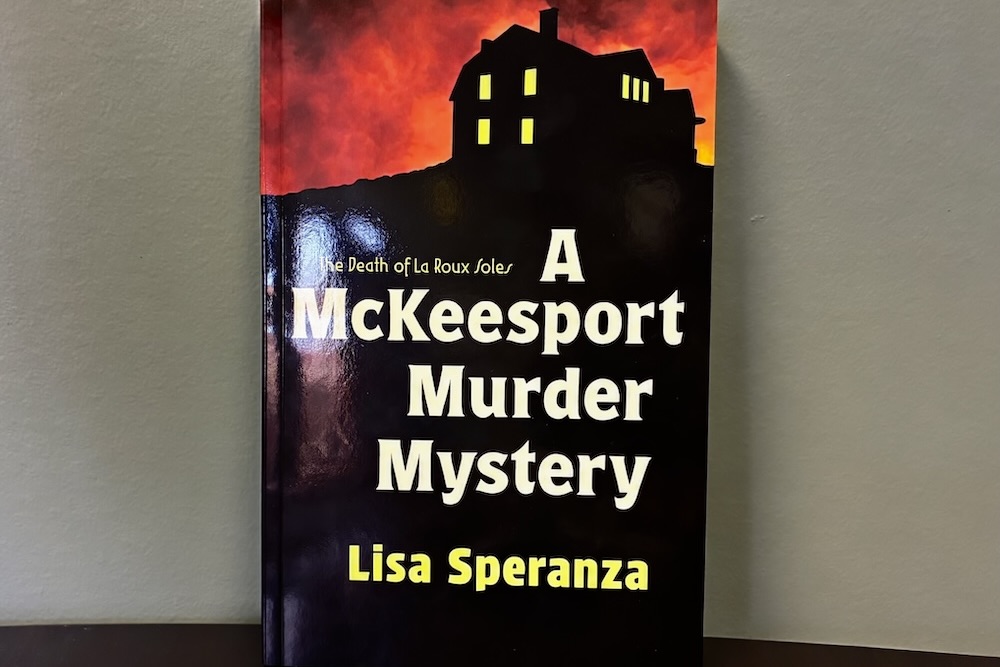
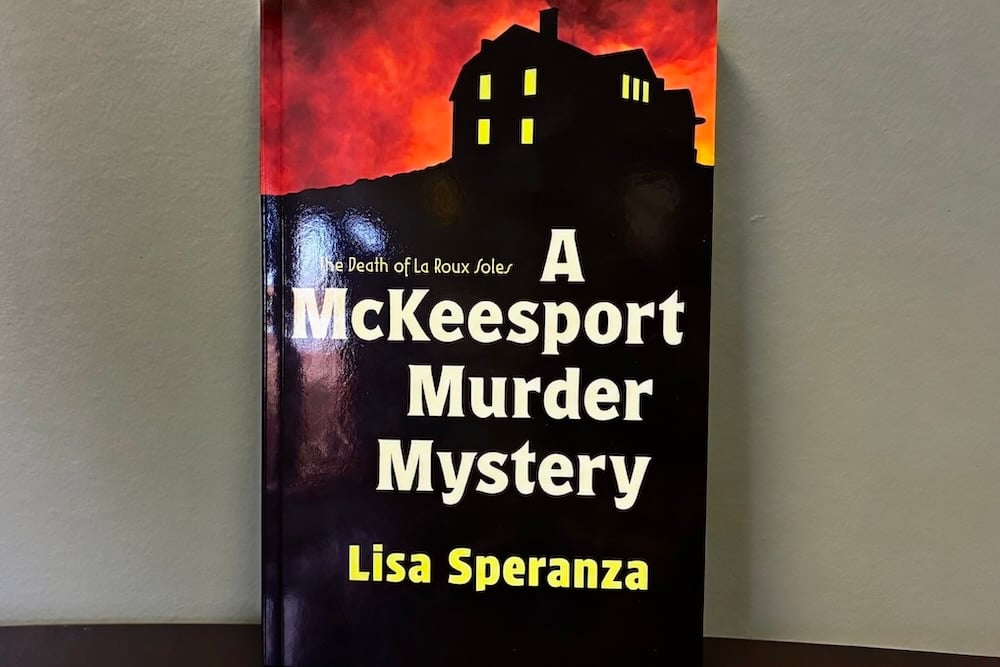
PHOTO BY OLLIE GRATZINGER
This article contains spoilers for the book “A McKeesport Murder Mystery: The Death of La Roux Soles.”
It’s a story of death, mystery and intrigue, of booze and prohibition-era parties at a mansion perched high about the industrial heart of a gritty town — and it all really happened, just a stone’s throw from Pittsburgh in McKeesport.
The story belongs to La Roux Soles, a prominent McKeesport socialite whose 1933 murder is the subject of a new book by Pittsburgh author and historian Lisa Speranza.
“A McKeesport Murder Mystery: The Death of La Roux Soles” was published by History Press on Oct. 20. It explores Soles’ life, death and the subsequent trial of her husband, whose involvement in her death remains somewhat sheathed despite the fact that he was found not guilty by a jury in 1934.
Through newspaper headlines and firsthand archival research, Speranza pieced together a story that time nearly forgot. She says it was a labor of love more than a decade in the making.
“The story of how La Roux first entered my life is an interesting one. I’m not sure if I found her, or if she found me,” she says. “On lazy Saturdays, my friend Andi Cartwright — now a board member at the McKeesport Regional History & Heritage Center — and I would occasionally drive around McKeesport to look at the grand old houses that once lined its streets. … One day [in 2010], we randomly found ourselves at the doorstep of 2018 Jenny Lind Street, not knowing at the time that within that very same house in 1933, a woman named La Roux Soles once lay dying.”
An artist whom Speranza calls “a glittered jewel” in the introduction of her book, La Roux Soles studied at the Stevenson Art School at Third Avenue and Wood Street in Pittsburgh; her talent earned her a spot in the Associated Artists Exhibit in 1913. Sometime in the 1920s, she met and married Bob Soles, a prominent real estate developer and war hero. She later became a mother to Kenneth, who died as a toddler in 1926.
Her own death — perhaps a suicide, caused by grief over her young son’s passing, or perhaps a murder at the hands of an unkind husband — caused a media frenzy, but Speranza says there is more to her story than meets the eye.
“What I hope readers learn is that La Roux was so much more than what was later splashed across nationwide newspaper headlines,” Speranza says.
Speranza, a lifelong Pittsburgher who grew up in Lawrenceville and Bloomfield and currently lives in Robinson, delved into research, meticulously pouring over the newspaper reports and census data and even conducting interviews with the Gowaty family, who lived in the house after the Soleses. But the process was not without its difficulties.
“There was a specific challenge in finding primary documentation and source materials from La Roux herself. It was not uncommon for women of that time to be marginalized in the wider narrative, and much of what we have from La Roux was retrospectively covered in newspapers after her death,” Speranza explains. “It is vitally important for me as an author to take into account what the lived experience was like for those whose stories I’m trying to tell.”
She adds that while the case received widespread newspaper coverage, “the volume of reporting didn’t necessarily make La Roux any easier to understand.”
“In many ways, the challenge was separating the public narrative from the life she actually lived, using the surviving records to recover the person who had become overshadowed by the circumstances of her death,” she says.
Those circumstances are where Speranza’s book begins: On a summer evening in 1933, La Roux suffered a fatal gunshot wound to the heart. One question still remained: was the gunshot wound self-inflicted, as it appeared, or had the secrets Bob and La Roux Soles kept culminated in murder?
But, true to intent, Speranza’s account of the Jazz Age socialite dives far deeper than the question of who pulled the trigger. In a stunningly human tale, Speranza tells the story of a complicated and three-dimensional woman, shaped in part by the gilded glamour and stark dualities of the industrial town she called home.
A bustling metropolis at the height of its industrial era, McKeesport was dubbed “Tube City” for its National Tube Works, a steel tube foundry that saw money flow along the Monongahela River from its construction at the turn of the 20th century to its closure in the summer of 1987. While the plant became one of the largest manufacturers of its kind in the U.S., it was also marred by brutal industrial accidents involving extreme heat, heavy machinery, high-pressure steam, molten metal and moving rail cars — the other side of the coin, Speranza says.
“Looking through the lens of time to examine McKeesport in the 1930s allowed me to have a better understanding of what truly built the town. Much of this story takes place in a house that sat high on Jenny Lind Street overlooking the National Tube Works, offering a striking perspective on the contrasts within McKeesport,” Speranza says. “While the Soleses defied Prohibition with Jazz Age parties, many of the fortunes (and misfortunes) of McKeesport were being built upon the backs and blood and sweat of the workers who powered the mills in the valley below them throughout the day and night.”
It was in the shadow of that mill that La Roux Soles lived and ultimately died, but her story doesn’t stop there. Speranza made sure of that.
“I want people to understand that there was a complexity to La Roux that went far beyond the fragments left behind in old newspaper accounts. There is an enduring importance in how we judge other people, how public narratives shape a person’s legacy, and how a person’s life can disappear when they are defined by a single moment rather than understood in the context of their whole lives,” Speranza says.
The purpose of the book, which can be purchased through Arcadia Publishing, Amazon, the McKeesport Regional History and Heritage Center or local booksellers, is to restore Soles’ agency — something Speranza says was nearly lost to time.
“I want readers to recognize the humanity of the people involved and understand that the questions this story raises are not confined to the past. Most of all, I want them to know that La Roux was not only the headlines that were written about her. She was a woman with a story of her own and a voice that vanished on a warm June night in 1933,” she says. “I want readers to know how much I appreciate them keeping La Roux’s story and her name alive, nearly a century later. It means that what she went through mattered — and still does.”
The McKeesport Regional History and Heritage Center is also hosting a book launch event with Lisa Speranza on Sunday, Nov. 8, from 1 to 2:30 p.m.