Three New Dinosaurs Will Soon Be On Display in Pittsburgh
The fossils have been loaned by Kenneth C. Griffin, who also donated a $5 million gift to support the Carnegie Museum of Natural History’s paleontological research.
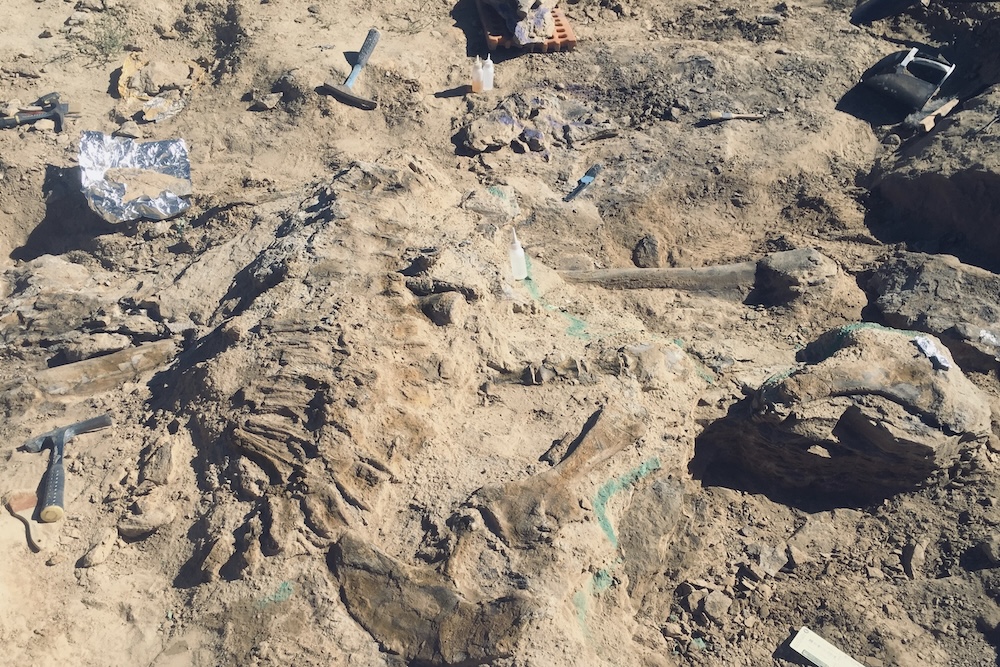
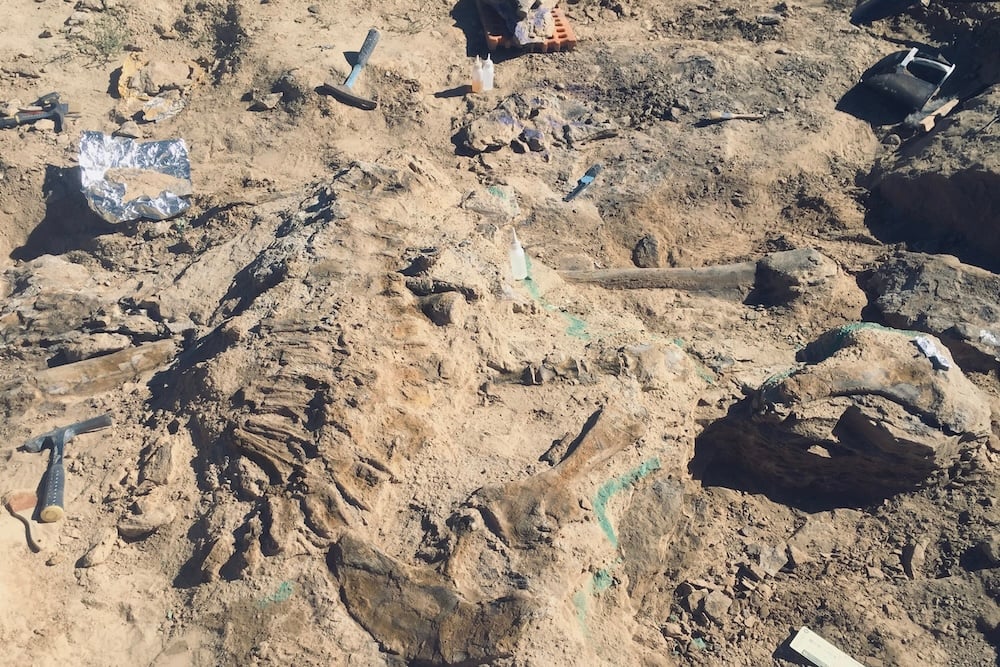
A DONE IMAGE OF G QUARRY WITH BONES IN SITU. | PHOTO BY SOTHEBY’S & FOSSILOGIC LLC
Pittsburghers: Meet Daisy, Lucky and Lucy. They lived some 150 million years ago, and they’re excited to meet you.
The three sauropod dinosaur fossils will be coming to the Carnegie Museum of Natural History in a decades-long loan facilitated by Kenneth C. Griffin, founder and CEO of Citadel. Griffin, who donated a record-breaking $3 billion to Carnegie Mellon University earlier this year to open a campus in Miami, also gave a gift of $5 million to the natural history museum in support of its paleontological research, educational programming and public engagement.
“Daisy, Lucky and Lucy offer an extraordinary window into our planet’s history,” Griffin said in a statement. “I hope these experiences spark curiosity and inspire the next generation of scientists.”
Discovered together in roughly 150-million-year-old rocks belonging to the Morrison Formation in Wyoming, the remains of these long-necked, plant-eating dinosaurs offer a rare opportunity to investigate how sauropods grew, developed and may have interacted with one another, officials say. While further research is needed to determine whether the adult, Daisy, and two juveniles, Lucky and Lucy, represent a family group, displays of multiple individuals of the same dinosaur species from a single quarry are nevertheless uncommon worldwide.
Griffin’s financial donation will support a new, visible fossil preparation laboratory that will allow museum scientists, preparators, interns and technical staff to work on specimens while the public observes. Fossil preparation can take years to complete and often remains hidden from public view. Officials say this initiative will invite visitors into the scientific process, allowing them to witness discoveries, conservation work and ongoing research in real time.

RECONSTRUCTED SKELETONS AND BODY SILHOUETTES OF THE THREE SAUROPOD DINOSAUR INDIVIDUALS BEING LOANED TO CARNEGIE MUSEUM OF NATURAL HISTORY BY KENNETH C. GRIFFIN, WITH PRESERVED BONES COLORED. TOP, “DAISY” (ORANGE); LOWER LEFT, “LUCY” (PINK); LOWER RIGHT, “LUCKY” (GREEN). RECONSTRUCTIONS ARE NOT TO SCALE; “DAISY” IS FOUR TO FIVE TIMES LONGER THAN “LUCY” AND “LUCKY.” | IMAGE BY SOTHEBY’S AND DR. SCOTT HARTMAN
Still partially embedded in the rock where they were found, the fossils will allow visitors to “experience discoveries as they unfold” while the museum’s paleontologists prepare the specimens for future research and exhibition.
“Carnegie Museums was founded on the belief that art and science have the power to transform lives and strengthen communities,” said Steven Knapp, president and CEO of Carnegie Museums, in a statement.
Museum officials also say Griffin’s gift will bolster the paleontological research for which Carnegie Museum of Natural History is known.
Renowned for discoveries that helped define modern dinosaur science, the museum is home to one of the world’s most significant dinosaur collections, including the iconic Diplodocus carnegii (“Dippy”), whose casts introduced generations around the globe to these prehistoric giants.
The museum’s collection also includes numerous holotype specimens and fossils that remain foundational resources for researchers studying dinosaur evolution, anatomy and behavior, officials add. Building on more than a century of dinosaur research, the museum will use its in-house expertise to study how dinosaurs like Daisy, Lucky and Lucy dinosaurs grew, lived and interacted with one another. Museum researchers will also analyze fossilized skin samples associated with these specimens, which are among the most extensive sauropod soft-tissue samples ever found.
The donation from Griffin follows a gift of $25 million last year by two longtime museum patrons, Daniel G. and Carole L. Kamin, that is being partially used to renovate the “Dinosaurs in Their Time” exhibition. The Kamins’ gift is the largest individual contribution made since the natural museum was founded in 1895. That donation also led to the renaming of the dinosaur exhibit as the Daniel G. and Carole L. Kamin Hall of Dinosaurs.
“This partnership presents an extraordinary opportunity to bring the public directly into the practice of science,” said Carey Scheide Miller, Daniel G. and Carole L. Kamin director of Carnegie Museum of Natural History and vice president of Carnegie Museums, in a statement. “We are deeply grateful to realize our vision of a museum where science comes to life and inspires curiosity about the natural world.”