Pittsburgh Honors 25 Fallen Officers With New Gravestones
The local officers died in the line of duty between 1871 and 1946 and have been buried in unmarked graves, officials say.
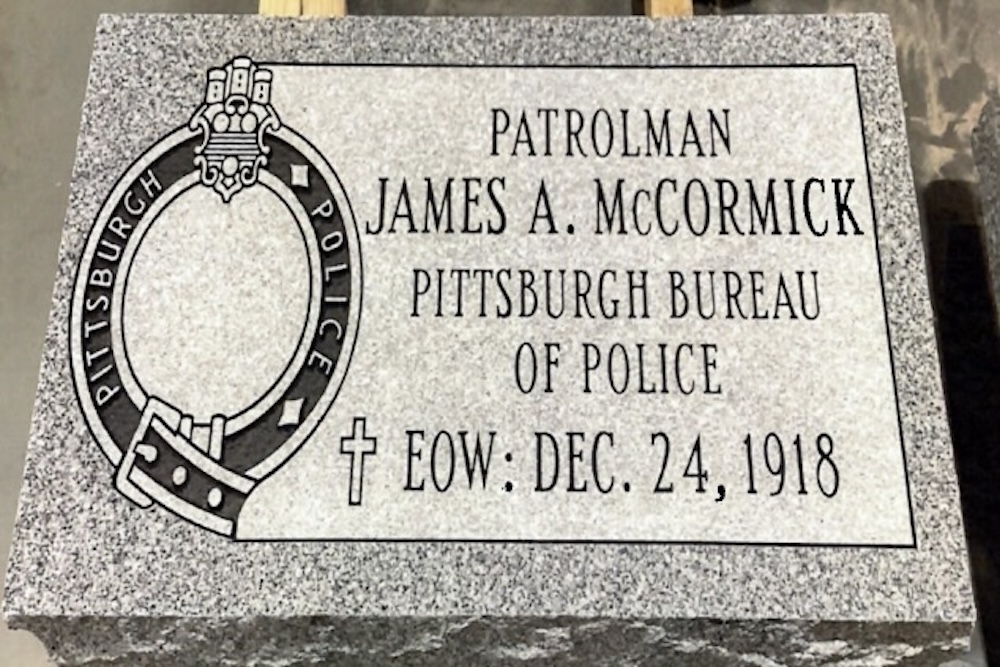
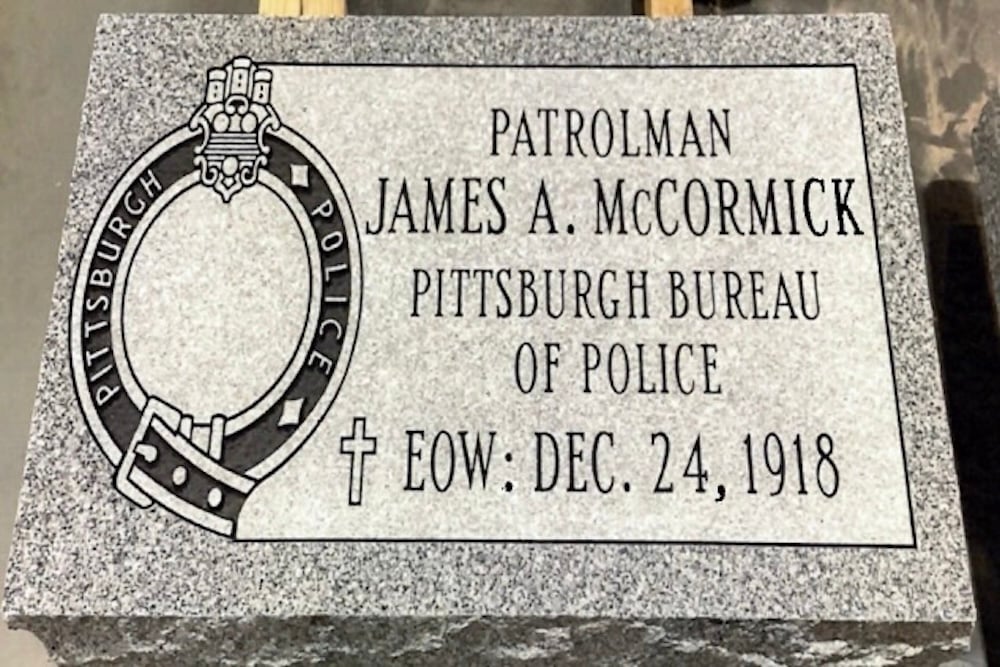
PHOTO COURTESY OF THE CITY OF PITTSBURGH/LAW ENFORCEMENT OFFICERS MEMORIAL | PATROLMAN JAMES A. MCCORMICK DIED OF SPANISH INFLUENZA DURING THE HEIGHT OF THE 1918 PANDEMIC
On Christmas Eve 1946, Patrolman Louis G. Spencer of the Pittsburgh Bureau of Police was jolted awake by the sound of gunfire.
Spencer bolted from his home in the Hill District to help; what he found was an armed man shooting through a neighbor’s Erin Street window. Although he was off-duty and not in uniform, he gave chase to the suspect through a layer of the Steel City’s industrial haze — something the day’s weather report described as “sky-obscuring fog.”
In a beat, the suspect stopped, paused, turned toward Spencer and raised a gun. He shot Spencer through the heart — but not before the off-duty officer was able to return fire, striking the assailant in the hand. He was later apprehended and sentenced to 10 to 20 years in prison.
It was an act of courage that led Spencer to posthumously receive the Distinguished Service Medal, Pittsburgh’s highest award for bravery. He was the first person to ever receive it after death. At the ceremony, his widow Laura Spencer told a local newspaper that she “always felt that [her] husband would die helping others.”
Spencer is just one of the 25 fallen police officers who will soon be commemorated as part of a new Pittsburgh-backed initiative.
In partnership with the Law Enforcement Officers Memorial and Peoples Natural Gas, Mayor Corey O’Connor has announced that more than two dozen officers who died in the line of duty between 1871 and 1946 will be memorialized with the new headstones. The officers are buried in unmarked graves.
The deceased are buried in eight cemeteries across Allegheny County, according to Molly Onufer, press secretary for the O’Connor administration. Three are in Uniondale Cemetery in Brighton Heights; one in Highwood Cemetery in Brighton Heights; five are in Calvary Cemetery in Greenfield; three are in Allegheny Cemetery in Lawrenceville; nine are in Saint Mary Catholic Cemetery in Lawrenceville; two are in Mount Royal Cemetery in Glenshaw; one is in Saint Michael Cemetery on the South Side and one is in Saint Mary Cemetery in Troy Hill.
“These 25 police officers, whose deaths occurred as a result of their line of duty, have never had a headstone or grave marker at their burial sites,” Donna Best, president of the officer’s memorial in Allegheny County, said in a statement. “They will now be honored and remembered for their great sacrifice to their chosen career as a police officer.”
Officials add that the process was a long one filled with historical research; Officer memorial historians Rick and Rocky Geppart were able to track down the names of the fallen officers, who represent four local law enforcement agencies: Pittsburgh Bureau of Police, Allegheny City Police Department, Allegheny County Sheriff’s Office and Swissvale Borough Police Department.
“The [officer’s memorial] has two very dedicated historians who are continuously researching line of duty deaths,” Best wrote in an email. She adds that the father and son team were able to identify which officers did not have headstones; the 25 selected were the only 25 without one, so the choice was an easy one.
Previously, the organization has placed wreaths at the graves of fallen officers whose final resting place lacked proper documentation. But thanks to a $25,000 donation from Peoples Gas, it will now be able to place the official headstones, which cost about $1,000 each.
Heath Peterson of Urbach Memorials coordinated with the eight cemeteries and all of the footers have been poured; headstones will be placed when completed. As of Nov. 16, one headstone is finished and will be placed before the end of the year.
“Heath has worked with us diligently in order to provide the most respectful and personalized headstones for all 25 of these officers,” Best wrote. “He personally designed each stone with the appropriate badge for the department of each officer.”
Officials say the grave sites tell stories that the city nearly forgot.
The earliest death occurred on Sept. 23, 1871; Patrolman Isaac Jones of the Pittsburgh Bureau of Police was kicked in the stomach while breaking up a fight near the intersection of Fifth Avenue and Wood Street, Downtown. He succumbed to internal injuries later that day. The latest death was Spencer’s, which occurred on Dec. 24, 1946.
In between are roughly two dozen similar stories showcasing the diverse range of threats law enforcement officers faced throughout Pittsburgh’s history. In 1894, Patrolman Peter P. Dillon of Allegheny City Police Department, was electrocuted by a downed wire at the intersection of Ohio Street and East Street on the North Side. In 1908, Patrolman Patrick Rodgers of the Swissvale Borough Police Department was killed and struck by a train in the area of Waverly Street and Noble Street while walking to work. In 1909, Deputy Sheriff Harry H. Exley of the Allegheny County Sheriff’s Office was killed during a period of rioting by steelworkers in McKees Rocks at the intersection of George Street and Nichols Avenue.
A few officers on the list also died while performing their duties during the 1918 Spanish influenza pandemic; Patrolman James Ambrose McCormick and Patrolman James Aloysius Dorsey, both of the Pittsburgh Bureau of Police, died of the disease in 1918 and 1919, respectively. During the worst days of the outbreak, one Pittsburgher fell ill every 70 seconds, and someone died every 10 minutes. The Officer Down Memorial Page says that the exact number of police officers who died from Spanish influenza may never be known, but there are currently 297 entries on the site listing the virus as the cause of death.
“These headstones are a reminder of the gratitude we owe those who made the ultimate sacrifice, as well as appreciation for the officers who carry on their legacy of service,” said Peoples Natural Gas president Michael Huwar in a statement.
For a full list of fallen officers, visit the city’s website; there are links to each officer’s write-up through the Officer Down Memorial Page.