Opinion: Three Things That Went Well During the NFL Draft, and Two That Could’ve Gone Better
Now that the 2026 NFL Draft is over, Associate Editor Ollie Gratzinger examines what went well — and what could’ve gone better.

PHOTO BY OLLIE GRATZINGER
All things considered, the 2026 NFL Draft went well. Although some Pittsburghers weren’t too happy with the Steelers’ picks, folks seemed to have a good time, crime rates were fairly low and public transportation to and from the event was fast and mostly reliable.
Now that the event has passed, we can take a look back with the gift of hindsight to see exactly how the city was able to pull it off — and how it could do better if such a large event comes our way again.
What Went Well
Transportation
Overall, Pittsburgh Regional Transit managed to do a pretty good job getting folks in and out of the Draft’s footprint. In addition to expanded service to routes that regularly serviced the area, the transportation network also operated four “Football Flyer” routes that carried travelers in from park-and-rides located north, south, east and west of the city, free of charge. The Football Flyers came often, and even though they were crowded, fans seemed generally pleased with how things went.
PRT and other regional transit networks had been preparing its fleet for quite a while ahead of the Draft, and a first-of-its-kind partnership with Sheetz allowed PRT to provide free fares on the Monongahela Incline and light rail. I heard quite a few fans on the 99N Thursday remark how excited they were that the buses were free, especially considering how expensive parking was near the Draft.

PHOTO BY OLLIE GRATZINGER | THE 99N, ONE OF PRT’S FOOTBALL FLYER ROUTES, CAUGHT AT THE ROSS PARK AND RIDE
There was some grumbling about park-and-rides filling up, though, and it seems that PRT had some problems handling the massive crowd on Thursday night when thousands of riders all wanted to leave town at the same time. The Pittsburgh Post-Gazette reported that riders had a difficult time getting through the crowd to board the bus, which extended how long it took to fill each bus and send it off. Additionally, hordes of walkers spilling into the streets blocked bus traffic, causing further delays.
Nevertheless, PRT changed tactics for the following night; a queuing system was put in place and enforced by police and public works crews, and no additional challenges were reported throughout Draft weekend.
Overall, PRT’s efforts within the Draft footprint place it firmly in the “pro” category.
Public Safety
With a record-number of attendees converging on the North Shore and Downtown during the three-day event, the city had its hands full. Factor in alcohol and rival sports team allegiances, and there was the potential for things to get ugly. However, city officials were on top of it.
There were police from local and state departments on all modes of transportation across the footprint; public safety officials had been planning and strategizing for the large crowd for the better part of two years. City officials were candid about concerns that such a large gathering in the national spotlight could be a target for violence, and told numerous media outlets that there is no such thing as being too prepared.
The safety plan involved a clear bag policy, metal detectors, a ban on flying drones, a fleet of bomb-sniffing dogs and planned shelter locations if bad weather were to strike. There were also medical forts throughout the footprint prepped to help the sick or injured.
It seems that all the preparing paid off. According to a recap from Pittsburgh Public Safety, the first day of the Draft made no arrests on the North Side, one misdemeanor arrest in Point State Park and four arrests Downtown. Two non-traffic citations were also issued Downtown, and one firearm was recovered from the area.

PHOTO BY OLLIE GRATZINGER | ARMED GUARDS ON PATROL INSIDE THE DRAFT FOOTPRINT
The majority of first-responder activity seemed to come in the form of 130 calls for EMS, mostly related to the heat. Pittsburgh Bureau of Fire was called to recover one lost engagement ring from a sewer grate — a mission that was ultimately successful.
On the second day, there was one citation issued within the Draft footprint on the North Side, four arrests Downtown once again and none at Point State Park. Five non-traffic citations were issued Downtown. EMS received 75 calls for service and transported 17 people to the hospital throughout the day.
On the third day, the recap says two arrests were made within the Draft footprint on the North Side, four arrests were made Downtown and none were made at Point State Park. There were nine non-traffic citations issued Downtown. There was one incident in which the Pittsburgh Bureau of Fire had to respond to a small fire caused by hot ashes from a grill. EMS received 24 calls for service and transported five folks to the hospital.
With almost a million people in a small place over the course of three days, Public Safety’s numbers demonstrate the fruits of their labor.
Lasting Beautification and Benefits
The city underwent a rapid clean-up in the two-ish years leading up to the Draft. More than 400 tons of litter were removed from the region since September 2025, when the city launched the “Immaculate Collection,” a widespread clean-up initiative.
Pittsburgh Magazine reported in March that the Western Pennsylvania Conservancy planned to fill 420 Downtown street planters with black-and-gold pansies grown in local nurseries and to adorn the city and its three Sister Bridges with 400 hanging baskets featuring snapdragons, petunias, pansies and verbena. The conservancy also planted trees and seasonal plants at its General Robinson Street community flower garden on the North Side, and added 400 trees across the region as part of the NFL Draft legacy project.
The Pittsburgh Downtown Partnership’s Clean Team was out painting rusty trestles and power-washing sidewalks, and more than $1 million has been raised to keep the process going long after the Draft itself.
“Our plan is to sustain this effort long after the Draft with the community’s support, so we can keep the region clean, beautiful and healthy for all residents,” Caily Grube, executive director of Allegheny CleanWays, said in a statement.
It may have taken the national spotlight to ignite the fire under Pittsburghers when it came to cleaning up our city, but fortunately, the ongoing efforts show no signs of stalling any time soon.
Beautification efforts aren’t the only lasting impact.
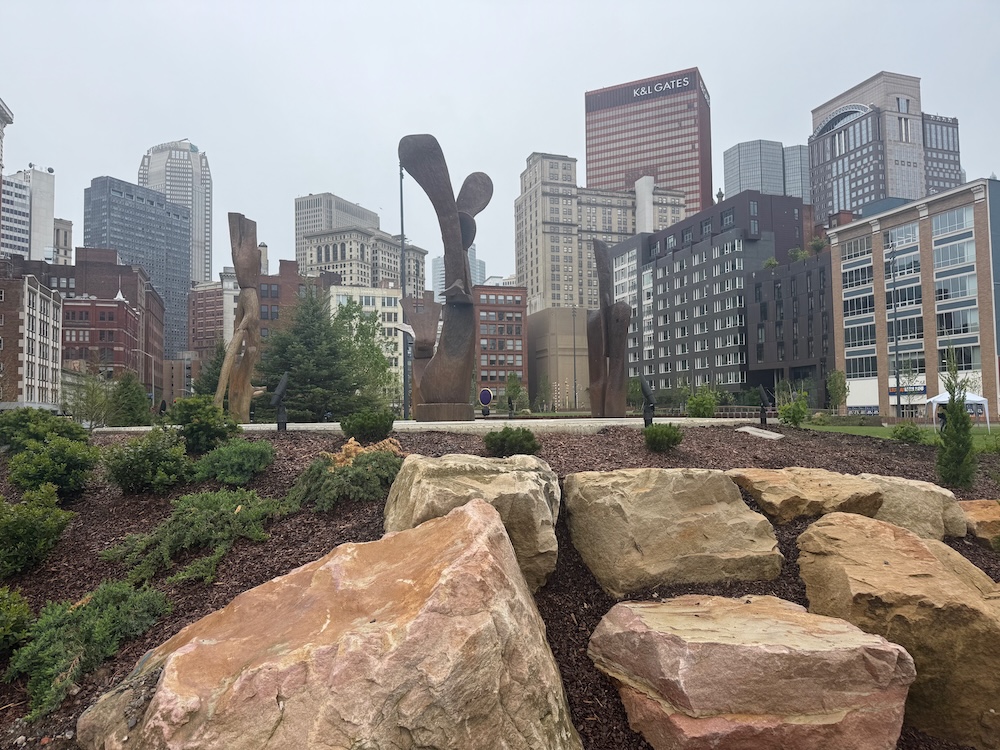
PHOTO BY OLLIE GRATZINGER | A STREET VIEW OF ARTS LANDING, A NEW VENUE AND GREEN SPACE IN THE CULTURAL DISTRICT
Construction on Arts Landing, a four-acre multipurpose green space in the Cultural District, was completed just ahead of the Draft, and the spot will serve as the permanent home of the Dollar Bank Three Rivers Arts Festival. It will also host a series of outdoor community events, art installations and public programming.
A series of informational window displays were also installed in the windows of “antique skyscrapers” on Downtown’s Fourth Avenue, complete with a QR code that links to a walking tour of the city’s architecture. This, too, was a part of Pittsburgh’s efforts to “redd up” ahead of the Draft, but it continues to draw locals and tourists alike, organizers say.
What Could’ve Gone Better
Small Business Benefits
Messaging was mixed ahead of the Draft. Massive signs on the highways told drivers to “avoid nonessential travel” during the Draft, and many companies encouraged their employees to work from home. Pittsburgh Public Schools, as well as Point Park University, were completely remote that week. As a result, the NFL Draft was not the financial windfall some businesses had hoped it would be. In fact, some small businesses didn’t even break even.
Pittsburgh Magazine reported that the majority of tourists stayed within the Draft footprint and didn’t venture out to the Strip District, Lawrenceville or other neighborhoods that had prepared to welcome them. Locals, intimidated by the Draft’s massive bark and the messaging by VisitPITTSBURGH, seemed to mostly stay home.
Public Source reported that Con Alma, a Downtown restaurant and live jazz venue, bolstered its staff, stretched the schedule and filled the fridge, all for an anticlimactic night and numbers that didn’t even reach what they’d expect mid-week.
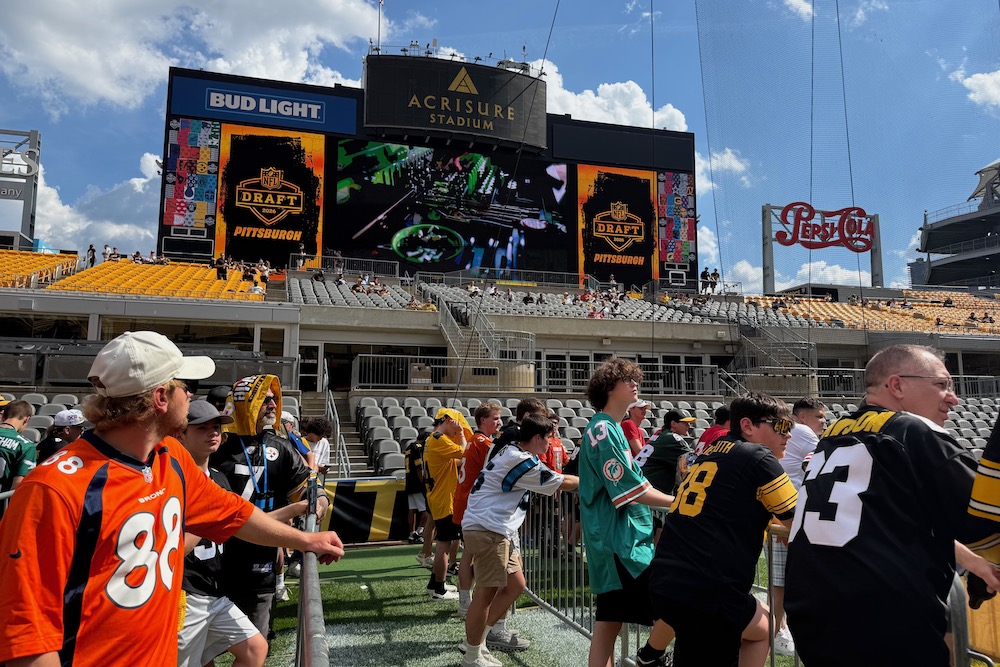
PHOTO BY OLLIE GRATZINGER | ONCE INSIDE THE DRAFT FOOTPRINT, FANS DID NOT LEAVE TO EXPLORE OTHER PITTSBURGH NEIGHBORHOODS.
Roland’s Seafood Grill in the Strip District also brought in extra staff for an “all-hands-on-deck” operation, according to PennLive, but the customers never came. Other businesses, like the apparel store PGH Sports and the 1:11 Juice Bar were left with extra merchandise and emergency plans to recoup their investments on products that didn’t sell.
So what went wrong? It’s hard to say for sure, but the hype around the Draft seemed to have scared people away. The highway signs straight up told people to avoid nonessential travel. While PRT did great getting folks around inside of the Draft’s immediate vicinity, it cut service elsewhere, meaning it was much harder for folks to leave the Draft for other neighborhoods like Lawrenceville and the Strip District once they got into town.
The massively inflated parking rates around the Draft also discouraged anyone from driving; Nearby garages and lots actually ended up reducing their prices by more than half when no one was able or willing to pay them. Traffic was unnaturally slow around the city during the Draft, and I was able to find street parking in Lawrenceville on a Saturday afternoon — something that would normally be unheard of.
Disruptions to Education
Pittsburgh Public Schools, one of the largest school districts in the region, transitioned to remote learning from April 22-24. District officials released a statement that said transitioning to asynchronous learning that week would “help reduce transportation challenges, minimize disruptions to school operations and ensure students can continue learning safely and effectively.”
However, studies have shown that students who learn remotely do not receive the same quality of education as those who learn in-person. Asynchronous learning is also not accessible to all PPS families. When everyone had to transition to online learning in 2020 due to the Covid-19 pandemic, wealth disparity and the “digital divide” took center stage; Public Source reported that more than 1,500 of the district’s then-23,000 students had no internet connection at home, and even more did not have enough computers or devices for each child to complete their schoolwork remotely.
While that number has likely decreased in the years since, it remains a fact that 63.1% of all PPS students are economically disadvantaged, 5.2% are experiencing homelessness and the majority of students in schools closest to the Draft footprint, like Allegheny 6-8, are not meeting state assessment measures. Learning from home also means its roughly 20,000 students were cut off from the free daily breakfasts and lunches they receive at school, and parents were left with a childcare conundrum.
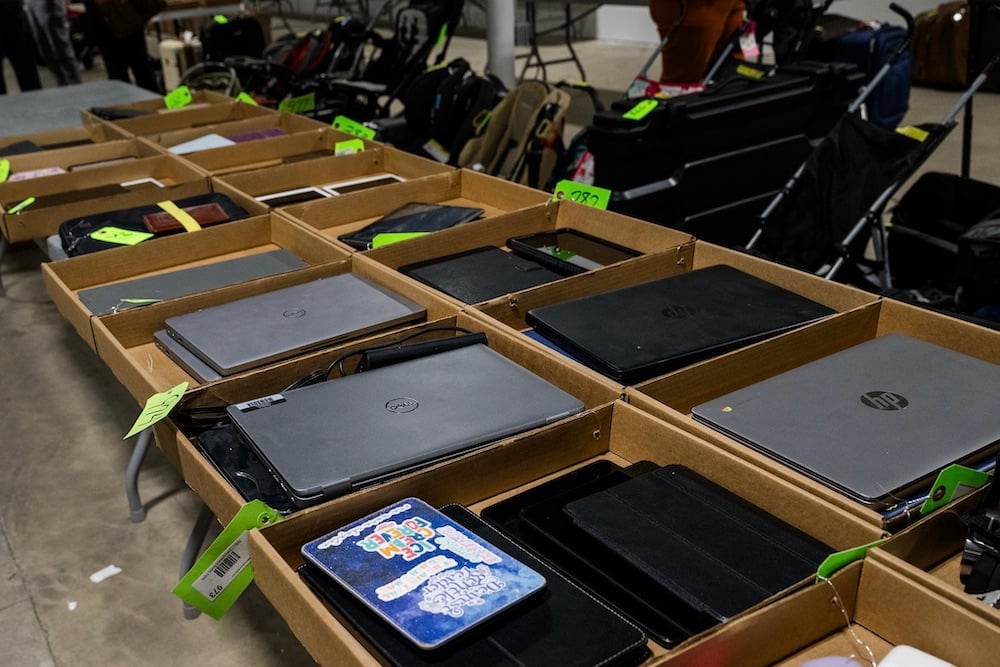
On top of accessibility concerns and the digital divide, Public Source reported last week that many students report technology hiccups during remote learning days, especially when using the older, cheaper Dell laptops most PPS schools provide students.
The Draft also occurred during the first week of the 2026 Spring PSSA testing window, which meant the testing schedule for the important state-mandated exams had to be adjusted.
Ahead of the Draft, a columnist for the Washington Post brought the question of public education to a national audience, writing that “the school district’s decision sends the wrong message.” The majority of Pittsburgh’s schools are nowhere near the Draft footprint, “separated from the area by rivers and bridges and hills and tunnels,” the column reads.
However, James Fogarty, executive director of the nonprofit A+ Schools Pittsburgh, told the Washington Post that the creation of magnet schools throughout Pittsburgh a few decades back has complicated matters, and only about one third of PPS students go to their assigned neighborhood school. It may have been difficult for students to get from one neighborhood to another, especially if they take public transit, which students at Pittsburgh CAPA, Pittsburgh Milliones, Pittsburgh Obama and Pittsburgh Science & Technology Academy rely on to get to and from school.
The state of education, both in Pittsburgh and throughout the U.S., is its own can of worms worthy of a half dozen columns. It just seems that school districts are too quick to favor remote instruction days instead of just cancelling school and extending the academic year by a day or two to make up for it, which used to be the go-to method pre-pandemic.
A 2025 study by the Center for Education Policy Research at Harvard and Stanford’s Educational Opportunity Project showed that students within Pittsburgh Public Schools are significantly behind pre-Covid achievement levels, nearly a full grade below mark in math and half a grade below mark in English. It’s clear that remote instruction isn’t working, and our students are falling behind. Pushing school online for a sporting event — albeit a massive and historic one — feels like it’s sending mixed messages about priorities and the importance of education.