Ready or Not, A Data Center Boom is Coming to the Pittsburgh Region
Large-scale AI campuses are proposed across Southwestern Pennsylvania, promising investment while fueling fears over energy, noise and secrecy.
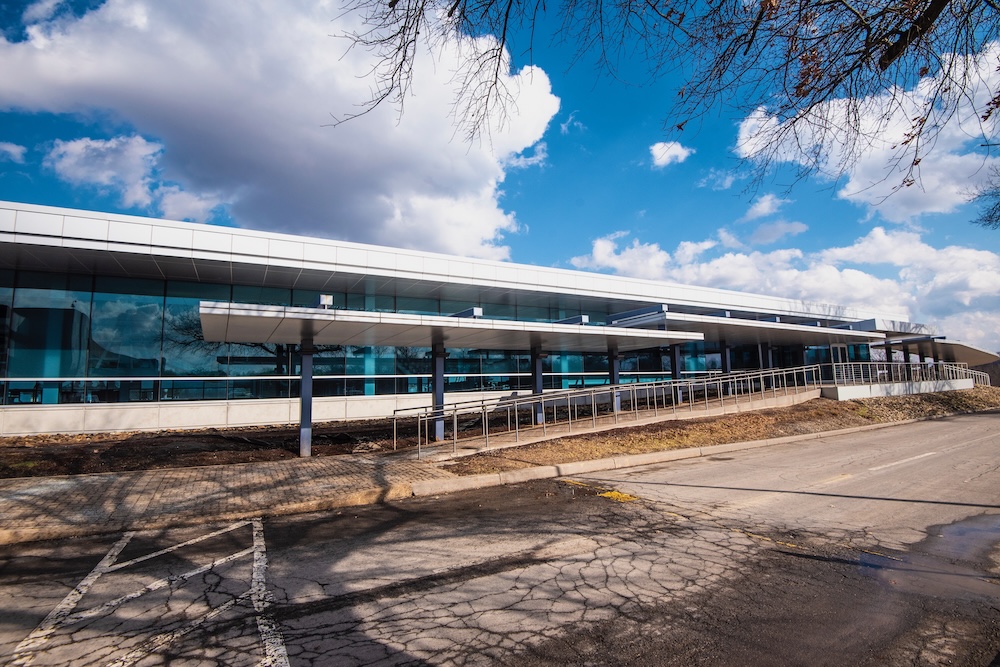
DATA CENTER PHOTO BY HUCK BEARD
South Strabane Township tried to calm the clamor about data centers.
“We are aware of several social media posts circulating that suggest there will be agenda items related to Data Centers at the December 16th Township meeting,” read a statement posted on the Washington County community’s website prior to December’s Board of Supervisors meeting. “There will be NO agenda items pertaining to Data Centers…”
The post did, however, acknowledge some facts behind the rumors. “CNX has explored the possibility of Data Centers on a large parcel,” the statement said.
Just in case, township officials noted that they were developing an ordinance for such centers. Shippingport has already passed one, Gilpin Township recently approved one, and Robin Lesko of the environmental group Food and Water Watch says several other local communities are doing so, too.
There’s good reason.
Data centers are swelling in size and number in Southwestern Pennsylvania and around the country, spreading hopes of prosperity and fears of blight. The Pittsburgh region has scores of small centers, and leaders are trying to catch up to Virginia, Ohio and other states, which already have huge centers — dubbed by some as AI factories.
Besides more traditional digital chores, those centers smelt data, forge it into artificial intelligence and ship it for use in business, research and homework.
At press time, the Florida company TECfusions was converting the first of several old buildings at a former Alcoa research site in Upper Burrell into an AI center, with plans to convert the rest of the buildings and, if demand grows, construct new ones.
Meanwhile, complex teams of data companies, utilities, hedge funds, and other businesses from Pittsburgh to Australia were known, or at least rumored to be, reclaiming brownfields, getting permits, seeking data clients and taking other steps toward AI centers in many local communities, among them Springdale, Stowe, Midland, Shippingport, Hookstown, Aliquippa, Monongahela, Big Beaver, Indiana County’s Center Township, and Washington County’s Robinson and Union townships.
The gleaming shrines to high tech would mostly be built on the sites of old mills, mines, power plants and other blue-collar landmarks.
Officials for some developers say they are just exploring their options around the region. Matt Virgin of SunCap Property Group has persuaded leaders in Stowe to pass rules for data centers, but says his company hadn’t decided whether to build one at its property at the former Pressed Steel Car site.
Other developers are revealing little or nothing about their plans for data centers.
“There’s so much mystery,” says DJ Ryan, director of communications and strategic initiatives for the Southwestern Pennsylvania Commission. “There are rumors just about everywhere about potential new data centers.”
Developers typically negotiate big deals confidentially to get the jump on competitors. Patsy Esposito said he’d signed a non-disclosure agreement covering negotiations for his sale last year of an old Midland farm for a possible data center.
“You’re turning empty land into taxable land,” he says. “You’re seeing a rebirth.”
But some officials wish developers would go public with their plans sooner. Dwan Walker is the mayor of Aliquippa, where a data campus already is expected; he’s also the borough manager of Midland, where a few data centers already are located. “When you come into somebody’s house, you wipe your feet, introduce yourself, shake hands,” he says.
In a January post, State Rep. Jamie Walsh, R-Luzerne, one of several lawmakers working on data center bills, said, “Residents have expressed frustration that decisions are being made without sufficient transparency or community input.”
Fans and Foes
Depending on definitions, a big data center might be called a hyperscale center. In that scenario, it could consist of at least 10,000 square feet, 5,000 servers and a capacity of 100 megawatts, equaling the average use in about 80,000 homes. It might be big enough to handle all the internet’s data several times over.
It also could generate some or all of the power it needs, or even extra for the electric grid, mostly from natural gas on site or nearby.
“Done right, these projects respect and empower local communities while creating new economic opportunities for all Pennsylvanians,” says Rick Siger, Pennsylvania’s secretary of community and economic development.
Dave Spigelmyer, senior vice president of Project Hummingbird LLC, which is planning a data campus at the former Robena Mine site in Greene County, adds, “We’re taking a brownfield and turning it into a jobs-producing engine.”
Based on interviews, brochures, public statements and press releases, projections per data campus range up to about 3,200 acres, 6 million square feet of buildings, $25 billion in investments, more than 15,000 construction jobs, 1,000 direct or indirect long-term jobs, $19 million in yearly taxes and other local benefits.
But local activists such as Lauren Posey, an environmental policy advocate at Protect PT in Penn-Trafford, say that centers elsewhere often fall short of their projections. And Katie Jones, Ohio River Valley coordinator of FracTracker Alliance, says, “Primarily, the benefits are for really wealthy corporations and much less so for everyday people. Does the average person actually need AI to summarize their emails?”
Proposals also have divided neighbors, according to Matt Housholder, chairman of Center’s board of supervisors in Indiana County, where there are tentative plans for a data campus.
“There’s people that swear how much noise and dust it’s going to make,” Housholder says. “Other people, it’s going to be the best thing that ever happened.”
Barb Michna, owner of the A’Brewed Awakening coffee shop near Aliquippa, thinks that a proposed center there would boost her business, but not everyone agrees. Jacob Wild, a customer at the cafe, says it may not be worth it.
“The constant humming, the bright light, it’s not going to be nice to live next to,” he says. “But everyone wants their phones, everyone wants the data.”
Devon McCullough hopes to sell his home near Springdale’s planned campus to escape the noise he believes it will create; others hope to sell their land to developers.
Dan Adamski, regional head of Jones Lang LaSalle real estate, which is marketing some potential data campus sites, says, “Everyone thinks they have a good data center site.”
Some public meetings about centers have been amicable, and others contentious. In Springdale, where famed environmentalist and “Silent Spring” author Rachel Carson grew up, some protest signs have asked, “What would Rachel say?”
Wired
Data centers devour power. The Lawrence Berkeley National Laboratory says that data centers accounted for 4.4% of the nation’s electricity use in 2023 and will likely reach 6.7-12% by 2028.
Three Mile Island Unit 1 is planned to restart under a Microsoft power purchase agreement while Meta is funding an expansion of the Beaver Valley Power Station. A 200-mile power “superhighway” has been proposed between Marshall County, W. Va., and Perry County, Pa. Federal officials also have announced a $17 billion “South Mon” plant by Florida’s NextEra Energy Resources at an unspecified site in southwestern Pennsylvania.
Critics say residents pay for the power generated in such centers. According to the U.S. Energy Information Administration, residential rates around the country rose 32% from 2014 to 2024, according to EnergySage. Bloomberg news reports wholesale prices near hyperscale centers spiked up to 267% during those years.
“Rising costs have already showed up in our bills because of the speculation of data center build,” says State Sen. Lindsey Williams, D-Allegheny, who’s working on price protections for residents.
And power pollutes, of course. The Open Energy Outlook Initiative, a collaboration between Carnegie Mellon University and North Carolina State University, says that data centers and crypto mines might boost 2030’s greenhouse gas emissions by 30%. Most centers would get backup power from diesel generators, which need frequent, noisy and sooty test runs.
Light, Noise, Vibration and Water
Adamski and other advocates say that data centers make far less noise and pollution than the roaring, belching industries of the region’s old steel industry, but as Sarah Sweeney, community organizer for the Center for Coalfield Justice in Washington, Pa, points out, the centers aren’t exactly environmentally friendly, either.
“We don’t want these companies to take us backwards,” she says.
According to most publicly known proposals from data center developers, buildings would be set back and screened. Lights would face inward. Perimeter volume would not exceed common conversations. Typical data clients would keep most of their workers off-site, limiting payroll taxes, but also traffic.
Still, the centers would run 24/7, humming and glowing.
“Nobody wants to look out their window and see bright lights on a monolith,” says Matt Mehalik, who leads the Breathe Project, a nonprofit dedicated to sharing air quality information in the Pittsburgh region.
According to Dark Sky International, Nova Group Pacific engineering consultants and other experts, light, noise and vibration hurt resident health as well as the environment.
It also takes an enormous amount of power for chatbots to respond to user questions, and keeping the bot’s servers cool enough to function in data centers can take a toll on the environment, says a report by The Washington Post in collaboration with researchers at the University of California, Riverside.
As an example, it takes more than a bottle’s worth of water to cool off a server after just a 100-word AI message. For an entire data center, the estimates of water usage vary widely, with some projections reaching far past one million gallons per day.
Centers might discharge heated water or let it evaporate, which opponents say raises local and global temperatures. Or they might chill it for reuse, which requires more power. Or they might rely on air-conditioning, requiring even more power.
Critics say data centers also boost water bills at a time when the nation’s average water and sewer bills already has climbed 24% from 2019 to 2024, according to Bluefield Research.
Make It Work?
While Pennsylvania’s bylaws allow communities to regulate industries, they are not permitted to ban them. Rich Fitzgerald, head of the Southwestern Pennsylvania Commission, urges residents not to greet data center proposals with “No, no, no!” but rather “How can we make it work?”
In February’s budget address, Pennsylvania Gov. Josh Shapiro promised to expedite centers that work openly with communities, provide local benefits, generate or pay for all their power, hire and train local workers and “commit to the highest standards of environmental protection.”
Posey, Mehalik and other local environmentalists recommend protections such as solar panels, pollution limits and enforcement penalties.
With technology ever changing, Springdale resident Carole Brennan, who has protested data centers in her community, says that, with the rapid increase in investment, the AI bubble might burst, leaving data centers as vacant shells dotting the area.
On the other hand, former Springdale manager Terry Carcella, who resigned from his position in March, thinks that’s a reason to hurry up and move forward with such centers, not hesitate on them.
“Whoever gets there first will get the business,” he says.
[Updated with correction: Patsy Esposito sold land in Midland last year to buyers considering a data center. Author Grant Segall reports Esposito has no further interest in the project. We regret the error.]