Marty Griffin Really Doesn’t Care If You Like Him
The opinionated KDKA Radio host has built a career on being controversial.

PHOTO BY BECKY THURNER BRADDOCK
It’s 10 a.m. on a Monday, and Marty Griffin is in motion — buzzing, really — in his studio at KDKA Radio’s Green Tree offices, ready to talk to Pittsburgh for the next four hours.
On this particular morning, the rundown for “The Marty Griffin Show” includes a conversation with KDKA’s Ray Petelin about overnight storms, a pair of segments on a controversial AI game circulating through middle schools and, inevitably, a return to one of his favorite topics: the state of Downtown.
Griffin, 66, has built a career on figuring out what people want to talk about, then talking at them. It’s part of what makes him such a polarizing figure (just type “Marty Griffin” into Reddit, and dive through the hundreds of comments calling him a “jackass,” a “paid agitator,” and “a scumbag desperate for views”).
Griffin is well aware of this. He hears from his critics constantly, but shrugs them off. The backlash, if anything, seems baked into his job, which has always been to embrace friction.
As a television reporter, he chased hurricanes in the South and spent weeks reporting on the Branch Davidian standoff in Waco, Texas. He, admittedly, pissed off a lot of people in Dallas (“It’s a whole thing. Google it,” he says.) before returning to his native Pittsburgh in the late 1990s to report the news.
His solo KDKA Radio show launched in 2019, and his style — opinionated and conversational to a fault — has become his calling card.
During his shift, Griffin is constantly engaging in real time with callers, critics and sources alike. His day begins early, at 4:15 a.m., with a routine that’s equal parts information gathering and endurance test.
“I go through all my emails, through the network news,” he says. “I read everything, every source I can. I work out for probably two-and-a-half hours. All that time, I’m texting people, answering messages, reading the personal stories that people send.”
It’s a level of connectivity he’s incredibly proud to have achieved.
“I’m more connected than any reporter in Pittsburgh,” he says. “Not to be a jerk, but I’m sitting here on my cell phone, and if you need it, I could get a roof on your house. I can get four cops to you right now. I’m not trying to be arrogant, I’m just saying, I’ve spent 30 years doing this.”
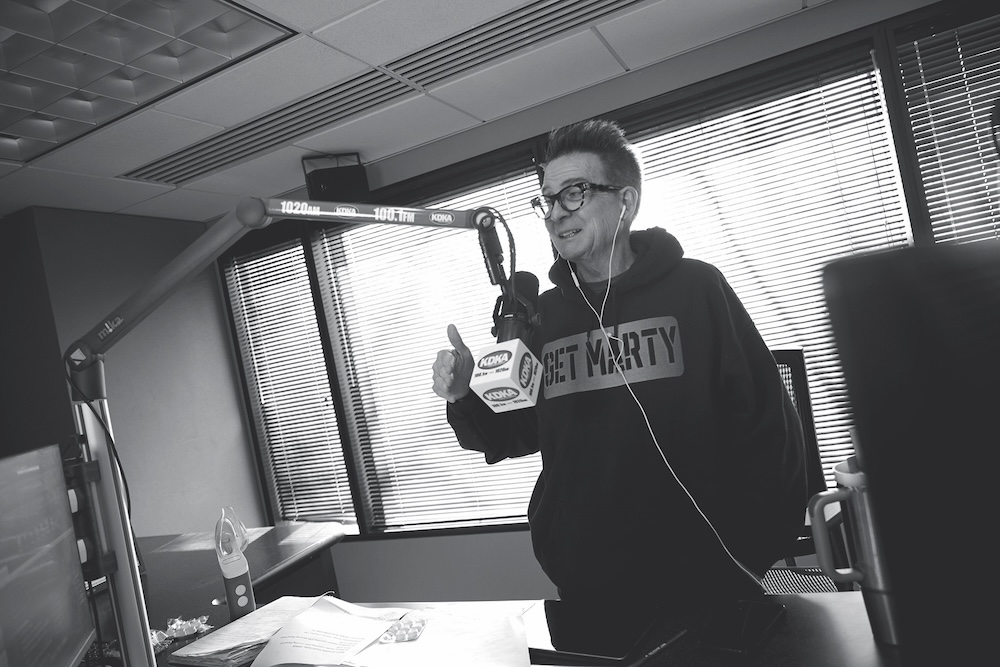
PHOTO BY BECKY THURNER BRADDOCK
That claim, like much of what Griffin says, walks a fine line between confidence and provocation. He knows how it sounds. He also knows it’s part of why traditional journalists often bristle at his approach. Griffin doesn’t pretend to be neutral; he takes positions, and he’s happy to argue them.
He also doesn’t claim to be a journalist. For him, he says, the goal isn’t objectivity or detachment — it’s impact.
“I’ve always kind of had that interest in making a difference. Someone called the show, and he needed a kidney. We went on social media, and we put out these videos, and we had a woman from Cleveland give him her kidney because she saw it,” he says. “Okay, you can say Marty Griffin is an asshole, but if I can make a difference, why not?”
That philosophy is perhaps most visible in his coverage of Downtown, an ongoing focus that has drawn both praise and intense criticism.
Almost daily, Griffin shares videos and stories to his social media pages highlighting drug use, homelessness and public safety concerns. It’s content that has earned him accusations of exploitation. But he pushes back — hard — on that characterization.
In his view, visibility can lead to action.
“I’m not saying we don’t screw up,” he says. “I’m not saying I haven’t made mistakes, because I have. But I’m doing it to draw attention to the big players that make decisions to change it or fix it, or find ways to help those people. And that matters.”
Off the air, his intensity softens, even if it doesn’t totally disappear.
Griffin has been married for more than 25 years to KDKA-TV anchor Kristine Sorensen; together they have three children, ages 21, 17 and 15. Dinner conversations are lively. His children challenge him, especially politically.
He welcomes it.
“My daughter is insanely liberal,” he says. “I’m a moderate. I pick a side, I don’t pick a party. I go at Trump; I love Josh Shapiro. I’m not exactly what everyone thinks I am.”
In 2018, he survived throat cancer, undergoing almost eight weeks of aggressive treatment at the UPMC Hillman Cancer Center. While his health is now good, he says enduring that diagnosis changed him for the better in many ways.
It also left him with a clear sense of what matters in life — and what doesn’t.
“I’m not for everyone,” he says. “And that’s okay with me.”