What’s The State of Pittsburgh’s Cultural District Today?
After the pandemic nearly destroyed it, Pittsburgh’s performing arts district is rising phoenix-like from the ashes — with a bright future ahead.
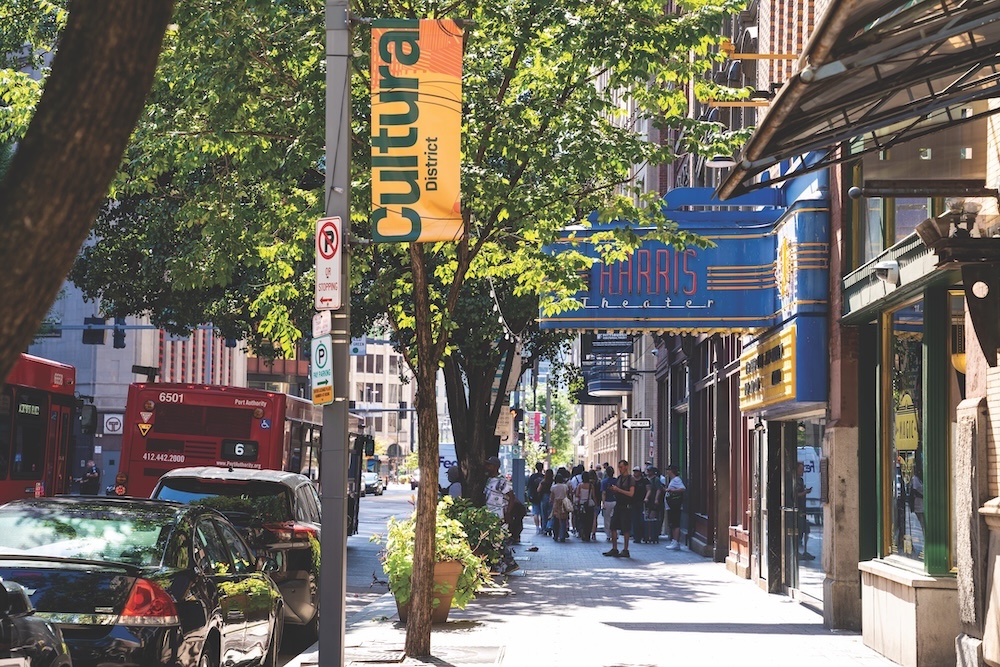
PHOTO COURTESY PITTSBURGH CULTURAL TRUST
A few years before COVID-19 shut the place down, Casey Henderlong looked out from Butcher and the Rye to find a cascade of people flowing her way.
Across Sixth Street, a show at Heinz Hall let out at 10:30 p.m. Some 150 people migrated en masse to Butcher and its sister restaurant Täkō, where Henderlong was the general manager that Friday in 2018.
“I thought: ‘Oh, my God,” says Henderlong, now a director at the Richard DeShantz Restaurant Group, which includes both hotspots in the Downtown Pittsburgh Cultural District within its portfolio. “We had a host at each restaurant to manage the flow of people. We were at capacity in both places.”
Since the pandemic was declared over in May 2023, nightlife destinations in the district are still hoping for a full revival of those pre-COVID, late-evening onslaughts. But businesses, nonprofits and civic leaders see recovery and evolution in the 14-block neighborhood, a bellwether for the arts community and the Downtown economy.
Monthly visits in the district are varying from about 68% to 96% of pre-pandemic levels, according to this year’s estimates from the Pittsburgh Downtown Partnership. July marked a high point with about 548,000 estimated visits, compared with around 573,000 in July 2019.
The figures, which show steady increases over 2025, exclude residents and many workers in the neighborhood. To buoy interest and activity, the Pittsburgh Cultural Trust arts nonprofit is investing in what president and CEO Kendra Whitlock Ingram terms “activation” — meaning more uses of buildings and public spaces, more visitors and longer visits. A high-profile example, the Arts Landing civic, recreation and relaxation space along the Allegheny River, has drawn around 1,500 daily visitors since opening in the spring of 2026.
It’s a better-than-expected boost as the Cultural District competes for attention amid changing habits and options for entertainment, according to arts advocates.
“The response from the community has been tremendous,” Ingram says, pointing to dog walkers, frisbee throwers, food trucks, live music and dancing taking place at the 4-acre Arts Landing, which also includes a playground. “It’s thrilling to see people using the space like it’s always been there.”
People spending more time in the Cultural District amplifies “the vibrancy factor,” she says.
The Trust wants more of that busy feeling, and not only when audiences pile into one of seven theaters and performance venues. An animated vibe is key to perceptions of liveliness and to economic impact, as longer visits translate to sales — parking, meals, drinks and other retail, Ingram says.
“You know what it feels like when you’re in a place and it feels ‘happening,’” she says. “[It] feels like a place I want to be. It compounds on itself.”
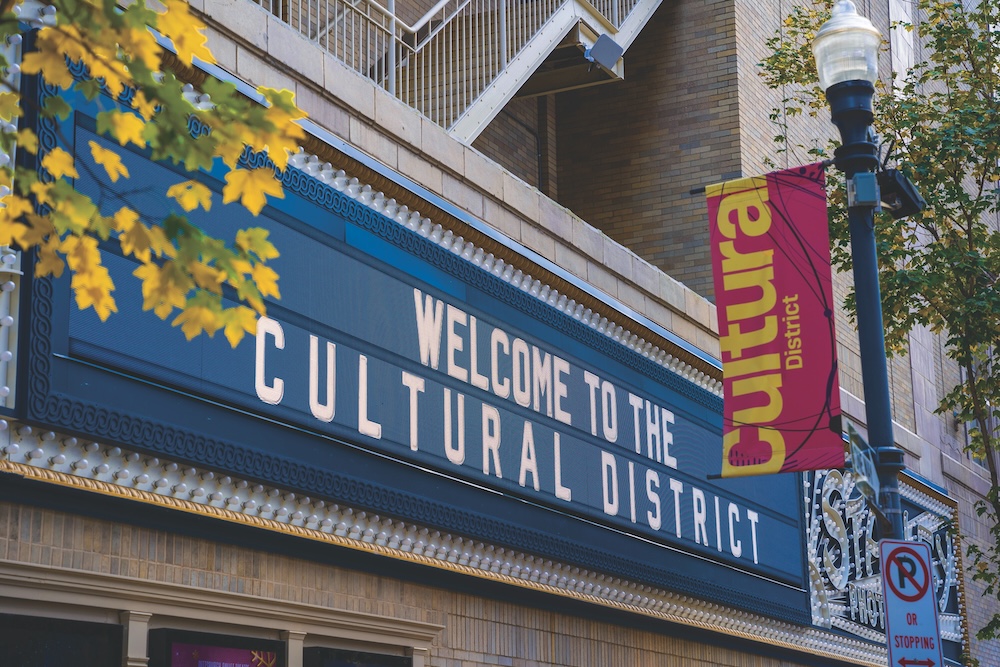
PHOTO COURTESY PITTSBURGH CULTURAL TRUST
From Red-Light District to Something for Everyone
Before the Trust took shape in 1984, what’s now the Cultural District had a rougher reputation: pornography shops and prostitution.
Heinz Hall for the Performing Arts, at Sixth and Penn avenues, was a singular bright spot among shoddy, rundown buildings, says Carol R. Brown, the Trust’s first CEO and president.
“I think, at the time, everyone in Pittsburgh just kind of accepted it,” she says of the red-light district.
The late H.J. “Jack” Heinz II, chairman of the H.J. Heinz Co., led a revitalization and reintroduction of the former Loew’s Penn Theater as Heinz Hall, which became home to the Pittsburgh Symphony when it opened in September 1971. As seedy commerce persisted around the venue, Heinz set out to protect the new crown jewel, Brown says.
An arts booster, Brown was seeking his help with another Downtown project in the early 1980s when Heinz floated his vision: a creative district that would safeguard Heinz Hall and clean up the neighborhood. Converting problem spots for arts uses would be pivotal, he said. And the Golden Triangle would gain economic development.
Brown was on board, going on to oversee the new Cultural District for nearly 20 years. Heinz juiced the effort with philanthropic largesse, providing its original funding before his death in 1987, she recalls. He died in February, months before the Benedum Center officially reopened following a $43 million restoration. Heinz “was daring in his tastes for the arts,” Brown says. “He had excellent taste.”
The Trust guided the district’s post-porn conversion as a legal entity to raise money, lead plans and buy properties for artistic use. Outside of Heinz Hall, early endeavors included the Harris Theater on Liberty Avenue (the former Art Cinema and once an adult movie house), the Benedum on Seventh Street (the former Stanley Theater) and the Byham Theater on Sixth (the former Gayety Theater).
Up until that point, arts groups had been more dispersed across the city, Brown says. After J. Kevin McMahon succeeded Brown in 2001, the Trust’s board charged the new CEO with filling seats and keeping the nonprofit on track.
“There was a spirit for those who were down there, at a certain point, that we knew we were creating something together,” says Jeffrey Carpenter, a founder of the Bricolage Production Co. that started in 2001. “There was a community” that cultivated cross-pollination and mutual support among artists.
McMahon went about bringing diverse offerings — cabaret theater, for instance — to Cultural District lineups that bigger organizations had largely to themselves. The Trust didn’t want to discourage legacy entities, such as the symphony and Pittsburgh Opera, but needed to introduce smaller groups and the spaces to suit them, McMahon says.
“We put a lot of energy into making sure that there was something in the Cultural District for everyone,” he says.
The Trust also bought up lingering porn shops, extended overall programming and worked through consolidations of arts organizations. It started art gallery crawls and delved into festivals and outdoors events, including the Dollar Bank Three Rivers Arts Festival.
As the Trust expanded, visitor projections for the Cultural District eclipsed 2 million a year when they factored in festival-goers at Point State Park and events outside of the Trust’s control. (Counts using new technologies have since become precise and targeted.)
The Trust branched into housing, too, partnering with private developers on the Encore apartment tower at 7th Street and Fort Duquesne Boulevard that opened in 2006. But almost the whole enterprise paused when the pandemic struck in 2020. Cultural District venues shut down for nearly two years. The Trust “basically went out of business” during that chapter, McMahon says.
“It was beyond comprehension to most of us,” he says. The Trust trimmed staff to a couple dozen workers “to keep the buildings from falling apart and to raise some money, even though we weren’t doing any performances.”
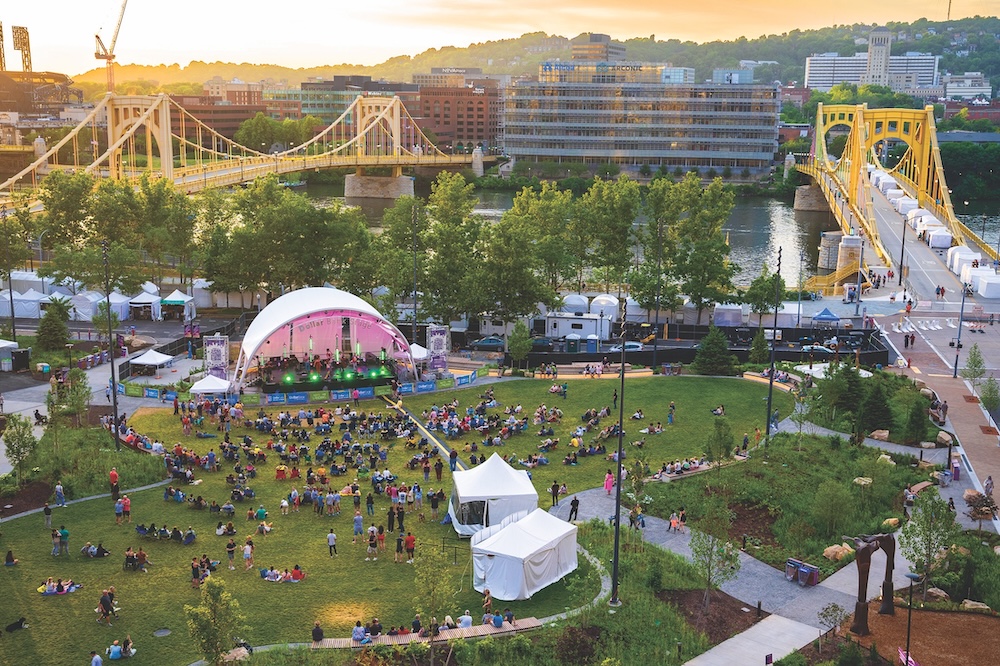
PHOTO COURTESY PITTSBURGH CULTURAL TRUST
A New Landscape For The Arts
While live shows returned after the pandemic, some performing arts remain under pressure.
Observers say the pandemic accelerated pre-existing trends of fewer people attending theater shows on a regular basis. That dented the subscriber model, in which patrons buy tickets for an entire season of shows. Groups reliant on that revenue are adjusting to more sporadic ticket-buying habits, even as certain shows in Pittsburgh notch record-breaking attendance. What’s more: Live performing arts continue to tussle with digital streaming services for time and affection, says Gregorio Lucena Scarpella, director of the Global Cultural Districts Network.
“They have been competing against people wanting to stay home,” says Scarpella, who is based in France and visited Pittsburgh over the summer.
Other hurdles vary from the rising cost of living to “a crisis of relevance” that leaves some audiences wanting different creative content, he says. “This is a fine balance to find.”
At the Heinz Endowments, a longtime contributor to the Trust, Jasmin DeForrest sees the Cultural District at a pivotal moment that “could bring forth great transformation.”
“We know that audiences are changing — the way they engage in the arts, the way they engage in the performing arts,” says DeForrest, the managing director of arts and culture at the philanthropic foundation.
The Trust’s work to understand audiences and track data will help the Cultural District thrive over the long term, she says.
By 2023, attendance at Trust events reached 92% of pre-pandemic levels, with interest especially strong for Broadway tours, contemporary dance, cabaret and a few other programming lines, according to the organization. The count includes programs controlled by the nonprofit in more than the 1 million square feet of real estate it manages.
For Pittsburgh Ballet Theatre, which stages shows at the Benedum, the last few years have brought blockbuster turnouts. Its “Wizard of Oz” in May 2025 ranked in the company’s best three shows ever for ticket sales, says executive director Nicholas Dragga.
“We attribute that to family programming and marketing,” he says. “It’s the family titles and familiar titles that people are really yearning for,” especially after the pandemic. Turnouts for the arts outside the Trust umbrella — but still in the Cultural District — are recorded separately.
In July, Pittsburgh Public Theater and Pittsburgh Civic Light Opera, or CLO, merged into a new entity called Confluence Theater of Pittsburgh. The two groups had been rebuilding ticket sales toward pre-pandemic numbers but faced higher operating costs and competition from other entertainment, says Laura Greenawalt, the transition project manager.
Local theater is increasingly up against concerts, dinners out and IMAX showings, she says. Merging helps the theater groups innovate, capitalize on their strengths and move toward sustainability, Greenawalt adds. The combined organization plans to lean into the Cultural District as an advantage while it matches shows to its best-suited venues.
“Downtown is a big part of our identity and what we’re working on. The Cultural Trust is a huge, huge part of that,” Greenawalt says. “We’re also looking for other partnerships as we grow, understanding there might be an opportunity in a smaller or more offbeat venue.”
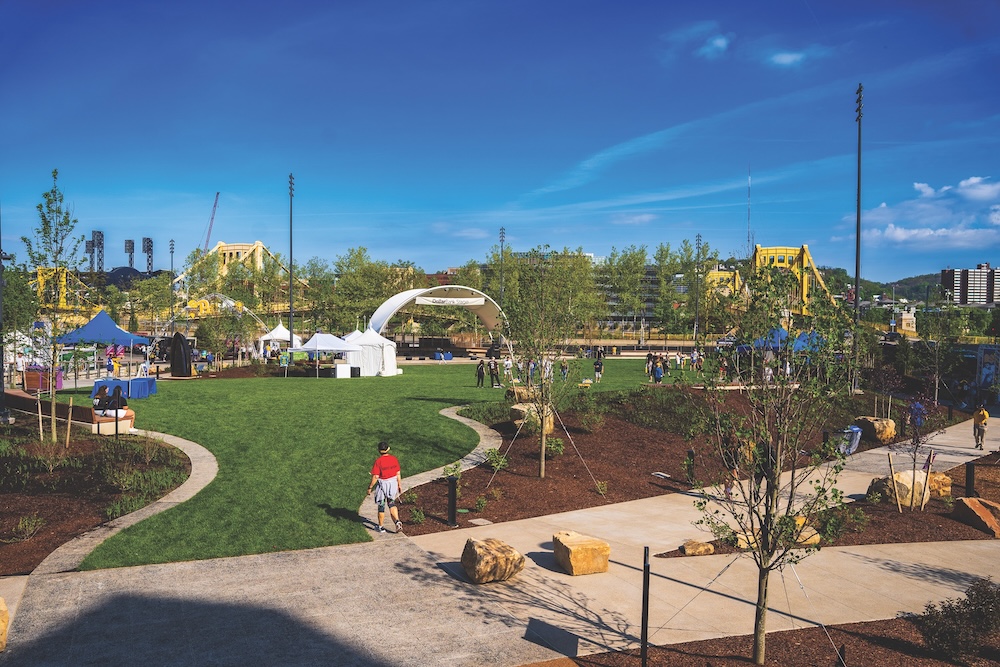
PHOTO COURTESY PITTSBURGH CULTURAL TRUST
Writing The Next Chapter
To stay healthy, cultural districts can create ecosystems that blend more than one draw for a good time, Scarpella says.
Developing variety starts “with understanding what you have and what you’re missing,” he says.
The idea is to offer enough attractions to cover nearly a day, capped with a ticketed event and nighttime activities after that. Pittsburgh’s Arts Landing contributes by filling a need for an outdoor gathering and green space.
“It’s not just a square; it’s not a closed theater. It’s something in between,” Scarpella says.
And it’s fast become a prime contributor for bringing visitors to Downtown. The new landmark logged 110,000 visitors during the arts festival in June. Sixty-five security cameras monitor as software tallies people coming into the Landing. Ingram set an overall goal of 1 million yearly visitors for the Trust’s own programming and attractions, up from the 600,000 recorded in 2025. Those numbers don’t account for Cultural District activities and business outside the Trust purview.
Lively art galleries, bars and restaurants, including the Trust-hosted Lounge at the Greer Cabaret, also help cultivate longer visits, Ingram says.
“Pittsburgh deserves more good things, and especially this area,” says Jimi Farrell, an owner-operator at the Wallflower bar that opened in June near the Benedum. “The more good things and the more choices you have, the more it feels vibrant, the more you can bounce around. It becomes more of a destination. In the short amount of time we’ve been open, we’ve seen a lot of that.”
Business at the Wallflower already has met expectations as the owners look to pair its momentum with Downtown’s, Farrell says. Some customers venture over from the North Side, drawn to new establishments.
Still, other regulars in the area vent ongoing concern over dirty alleys, drug activity and panhandling. At the ballet theater, Dragga credits the Trust and the Pittsburgh Downtown Partnership for prioritizing cleanliness, hospitality and safety. The Trust also is spending funds on security and technology, such as staff and cameras, to keep privately owned spaces in the Cultural District “safe and welcoming,” Ingram says.
“I wouldn’t say it’s a challenge. I would say the challenge is staying on top of it,” she says. “It requires constant maintenance and attention.”
Reversing impressions of the area as unsafe or inconvenient will take consistency and attention to detail, Dragga says. His take: The aggressive prep work that went into readying Downtown for the NFL Draft in April should be routine. The ballet theater staff has noticed people spending more time in the neighborhood.
“We just need to keep at it and give it time,” Dragga says. “We’re not going to change a whole perception in six months or 18 months. I think it’s going to take a while to build that trust.”
Draft attendees delighted in “authentically Pittsburgh” small businesses they found between Market Square and the North Shore, Downtown Partnership CEO Jeremy Waldrup says. The nonprofit community development organization is angling to help independent retailers through a new placemaking grant available Downtown, including the Cultural District.
“The Cultural District is and has been an integral part of Downtown’s growth and evolution,” Waldrup says. “When you look at organizations like the Trust and the theaters they represent and support — they are critical to bringing people into Downtown.”
Golden Triangle newcomers include residents as the partnership and city promote conversions of former office space. Nearly half of Downtown’s multi-family residential buildings, and about half the residential population, are in the Cultural District, according to the partnership. The neighborhood attracts smaller-scale investment in roughly 10- to 25-unit projects.
“Certainly, with the investments made in Arts Landing, we’re starting to see that even more on Penn Avenue, specifically,” Waldrup says.
Nearly 22,000 people live in the greater Downtown area, partnership data shows. Even for newcomers who don’t settle in the Cultural District, its attractions sweeten Downtown as a residential destination, civic leaders say. The same goes for the region as a whole, according to Stefani Pashman, CEO of the Allegheny Conference on Community Development. Pittsburgh outpaces similar-size cities for its breadth of arts, and “the Cultural District and the Cultural Trust are the tip of the spear in making that happen,” Pashman says. The range and concentration make “a really powerful selling point,” she adds.
Among overnight visitors, research shows nearly a third want cultural activities, says Jerad Bachar, CEO at the VisitPITTSBURGH tourism promotion agency. The proximity of Arts Landing to the David L. Lawrence Convention Center and other attractions creates a helpful layering of amenities, he says.
“It gives us a different product that can promote large-scale events,” Bachar says.
To keep venues brushed up and running well, the Trust is addressing deferred theater maintenance for the next several years — technical work to restore and replace mechanical systems. Visible projects will range from new audience seats at the Byham Theater to a restoration in Agnes R. Katz Plaza, where late sculptor Louise Bourgeois’ 25-foot bronze fountain stands as a centerpiece.
“If they continue to invest like this and make investments [for] larger projects like Arts Landing, I think they’re on a really good path,” says City Council member Bobby Wilson, who represents the Cultural District.
He says the Landing’s playground is a particular boon to families. To Farrell, strong business at a nearby venture where he’s a partner — Proper Brick Oven & Tap Room — seemed to augur well for Wallflower. He’s encountered recent tourists in town for a Pirates game who lingered an extra day to explore the area.
“We want to be part of this neighborhood, want to be part of the fabric of this neighborhood,” Farrell says of his business group. “We want to be part of the bounceback.”