Welcome to Pittsburgh — The ‘Real’ Home of Pro Football
Through profiles of five football professionals, sports columnist Mike Prisuta explores the indelible bond between Western Pennsylvania and the gridiron.

PHOTO BY DAVE DICELLO
The sign that greets patrons immediately upon entry into the Touchdown Club, a long-standing bar and restaurant just a two-minute drive from Saint Vincent College, the home of the Pittsburgh Steelers’ training camp, is impossible to miss — and delivers much more of a declaration than it does a humble brag. “Birthplace of Professional Football, Latrobe, Pa. 1895”
Alas, it’s inaccurate.
According to research conducted after the Pro Football Hall of Fame was opened in Canton, Ohio in 1963, it was discovered the first player to be paid for his services was William “Pudge” Heffelfinger, who received $500 to play for the Allegheny Athletic Association against the Pittsburgh Sports Club on Nov. 12, 1892.
The game was played, as the Steelers’ Hall of Honor details, at Recreation Park in what was then known as Allegheny City, Pa., not far from where Acrisure Stadium sits today on what is now Pittsburgh’s North Shore.
Heffelfinger’s ground-breaking compensation was verified via the discovery of an Allegheny Athletic Association expense sheet confirming a “game performance bonus to W. Heffelfingfer for playing (cash) $500.”
The document is now recognized as “pro football’s birth certificate.”
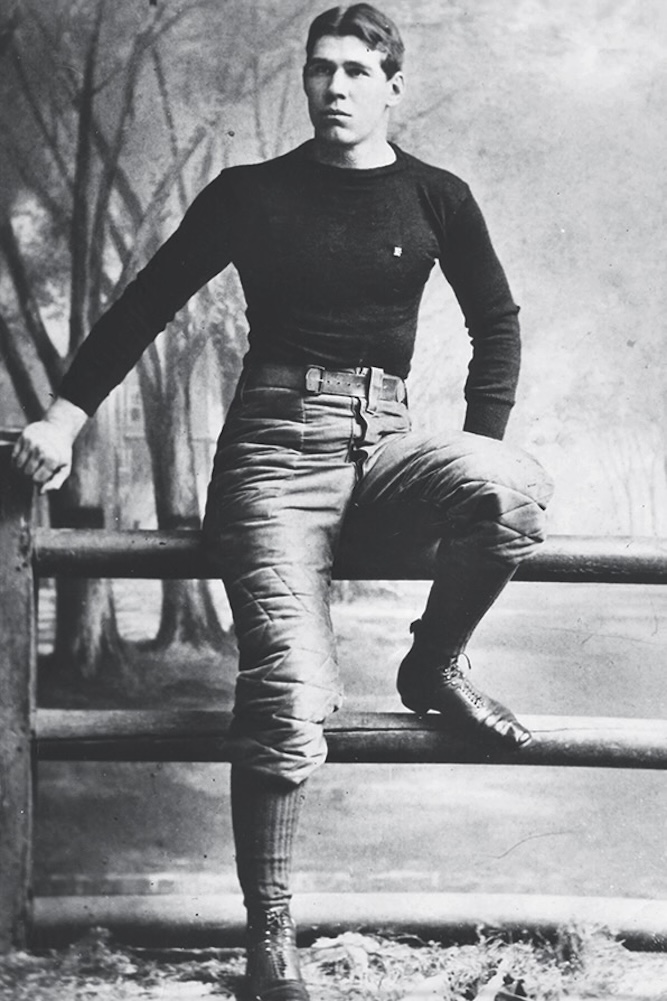
PUDGE HEFELFINGER: PHOTO ADOBE STOCK
Earlier pro football historians, according to the Hall of Fame, had previously agreed a 16-year-old quarterback from Indiana College, John Brallier, had been given $10 and “cakes” (expenses) to play for Latrobe against Jeanette on Sept. 3, 1895.
That remains the story in Westmoreland County, and the Touchdown Club is sticking to it. When you have Application for Membership cards on display once filled out by the likes of Terry Bradshaw, Jack Ham, Chuck Noll, Myron Cope and Fred Rogers — who had nothing to do with pro football but still, Mister Rogers! — maybe you still have some semblance of an argument.
What’s not up for debate, however, is how deeply professional football is woven into Western Pennsylvania’s DNA. It’s beyond a pastime or a passion. It’s part of the fabric of communities large (Pittsburgh) and small (Latrobe and countless others like it) that make up a region obsessed with professional football.
Which means the NFL Draft is finally coming home — even if, out of respect and reverence, it should be returning to multiple addresses.
In honor of the 2026 event, here are a few pro-football stories from a handful of Western Pennsylvanians who grew up with the game and eventually found a way to make it, as Noll might have put it, their “life’s work” in one form or another.
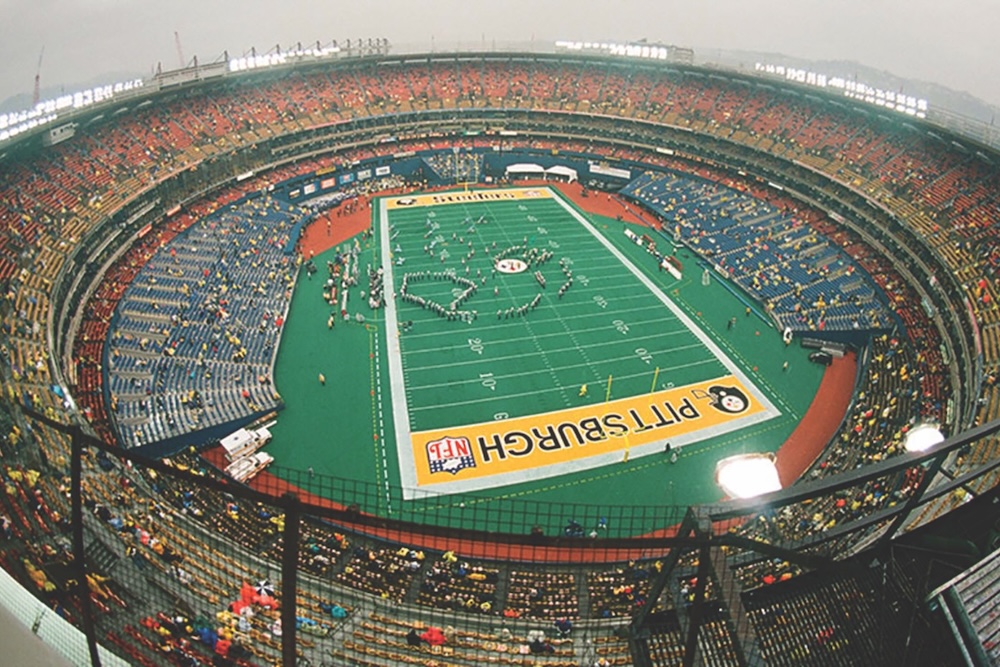
THREE RIVERS STADIUM PHOTO: ADOBE STOCK
Cigars and Bourbon
Matt Raich’s family had Steelers season tickets when he was growing up in Monaca in the 1970s and 1980s, so he remembers well the sights, sounds and sensations of Three Rivers Stadium, particularly how the first-level seats (which shifted from baseball to football configuration in the multi-purpose facility) used to shake when the crowd jumped up and down, which happened often in those days.
Raich also remembers the smells.
“Cigars and bourbon,” he recollects. “It was just so different coming from a small town, going to Pittsburgh.”
Growing up in those days also included trips to Saint Vincent College in Latrobe for Steelers training camp. “I’ll never forget watching those guys lift weights under a tarp,” Raich says. “Some of those trees are still there. I have photos of me with Jack Lambert and Joe Greene and Terry Bradshaw. “It was a dream come true.”
Raich also remembers wearing a “One For The Thumb” T-shirt in the ’80s. The slogan was popularized amid the Steelers’ quest for a fifth Super Bowl championship, and a fifth Super Bowl ring to go with those previously won at the conclusion of the 1974, 1975, 1978 and 1979 seasons. When the organization finally captured its fifth Vince Lombardi Trophy in 2005, Raich helped to secure it — serving as the team’s offensive quality control coach.
He spent this past season as a senior assistant/defensive line coach for the Indianapolis Colts, Raich’s 20th NFL campaign in a coaching career that has also included NFL stints with the Cardinals, Lions and Bengals as well as stops at Westminster (his alma mater), Robert Morris, Duquesne and Glenville State (in Glenville, W. Va). He’s even had turns with teams in Germany and in the XFL.
“I think it all started with me, my grandfathers on both sides — they just taught me about having pride and working hard,” Raich, 55, says. “One worked at Crucible Steel in Midland. The other one was at P&LE Railroad in Beaver Falls and Pittsburgh. And I think that whole area, with all the blue collar and people working with their hands, embedded in me, ‘I gotta work hard and give my best effort.’ “It’s how I got into the NFL, and I surely believe it’s definitely how I’m staying in it. You gotta work hard — and it is a hard job, for sure.”
She Swore at Him in Croatian
Mark Gorscak, who spent almost three decades as a scout for the Steelers, has a recognizable face (if not an unforgettable name), thanks to the many years he spent in command of the 40-yard dash at the NFL Scouting Combine in Indianapolis. The annual evaluation of top prospects for an upcoming draft is broadcast nationally on the NFL Network and devoured by those who have a particularly acute obsession with the NFL.
“People will stop me and say, ‘You’re the guy from the 40-yard dash, aren’t you?’” Gorscak says.
Sometimes they ask for pictures, Gorscak, 68, adds. He also gained a significant measure of after-the-fact acclaim as Joe Montana’s center at Ringgold High School in the early 1970s. Montana would go on to Notre Dame — and eventually a Hall of Fame career quarterbacking the San Francisco 49ers — but was more focused at the time on potentially playing basketball at North Carolina State, Gorscak remembers; there were also other, more immediate, concerns.
“You were just worried about getting a prom date back then,” he says.
Still, an appreciation of and a fascination with the NFL had been ingrained in Gorscak by his steelworker father while growing up in Donora.
“He made me swallow the Kool-Aid,” Gorscak says, “[with] stories growing up about my dad and my uncle Pete going to Forbes Field and Pitt Stadium to see the Steelers.”
Gorscak’s job at the time was to make sure the TV in his grandmother’s house next door was set to the proper channel on game day.
“She called Terry Bradshaw ‘Brady,’” Gorscak says. “She swore at him in Croatian … It was just a way of life in our house, football.”
Gorscak parlayed a coaching career — specifically a position as the administrative coordinator, recruiting coordinator and wide receivers coach at Weber State — into a job as a scout. Now, in the wake of a 28-year run with the Steelers, it’s Gorscak telling the stories for the benefit of future generations, as his father and uncle once did. Just prior to Christmas 1995, Gorscak attended his first Steelers game on the sidelines, having spent much of the season on the road evaluating talent.
“I had a sideline pass,” Gorscak recounts. “Neil O’Donnell was the quarterback. And I remember them coming to the sideline, they had stunk it up on offense. And Ron Erhardt was the offensive coordinator, and he had everyone around him sitting down and he was in the middle, and he was going to go over it.
“And he was just about ready and [linebacker] Greg Lloyd got in the middle and he said, ‘If you [expletives] don’t start scoring and keeping the defense off the field, I’m going to kick everyone’s ass.’ And he looked at Neil O’Donnell and he said, ‘And I’m starting with you first, Neil.’
“I heard that and I went, ‘Holy [expletive], welcome to pro football.’”

LATASHA WILSON BATCH AND CHARLIE BATCH. PHOTO BY ELLIOTT CRAMER PHOTOGRAPHY
My Name’s Dan
It’s often said in the NFL that game knows game. And it’s an absolute fact that Pittsburgh knows Pittsburgh. Homestead’s Charlie Batch cited an interaction during his playing days as a quarterback in Detroit with then-Chicago Bears head coach Dave Wannstedt, a Baldwin native and a Pitt alum.
“I was familiar with Dave Wannstedt,” Batch says. “I’m running into him during pregame and he’s like, ‘I had to alert my guys, we know what type of player you are. You’re from Pittsburgh.’ “And then I’m listening to his accent, and we just started talking.”
Batch worked his way up from Steel Valley High School to Eastern Michigan University to the Lions, where, in his second NFL season, he crossed paths with another Pitt product. It was August 1999 in Miami — Dan Marino’s final season with the Dolphins. Defensive end Jason Taylor, who attended Woodland Hills High School, also was on the Miami roster. Like Marino, he was on his way to the Pro Football Hall of Fame. Batch had gone to elementary school with Taylor.
Marino was a quarterback, a legend and “my idol growing up,” Batch says. “I get there and I’m trying to prep myself … on how to introduce myself to him because I don’t know if this dude’s gonna know me,” Batch explains. “I literally walk up to him and I say, ‘Nice to meet you, my name’s Dan.’ And he looks at me like, ‘What the [expletive] did you just say?’ I said, ‘Yeah, my name’s Dan.’
“I was so flustered I didn’t introduce myself as Charlie. I introduced myself as Dan Marino — because I was that dude as I was growing up, that’s who I wanted to be.”
Years later Batch, 51, and Marino have become “very good friends,” Batch says. “Every year at the Super Bowl we take a picture. [It’s the] Pittsburgh connection … Probably about 10 years ago, he ended up signing a jersey for me. My wife surprised me by reaching out to him and getting it autographed. He signed it and personalized it to me. I was like a kid in a candy store, ‘Damn, my idol actually signed a jersey for me and put my name on it.’ It’s in my basement, and it’s hanging up and it’s one that I truly treasure.”
What Batch treasures most of all from his 14 NFL seasons with the Lions and the Steelers are the relationships forged and the bonds established, not just with the legends of the league but with teammates.
“That camaraderie that you have, the principles that are instilled — trust, loyalty, teamwork, ultimately you build a lot of different things,” Batch says. “There’s nothing better than people from all different walks of life all coming together for one common goal, and when you do that, that is beautiful. Regardless of what color you are, what religion you are, everyone’s coming together. Eventually you stay together long enough that you become family.
“You build relationships with players and you build relationships with their families that cannot be taken for granted.”

PHOTO BY FEIXU CHEN/ NEXT GENERATION NEWSROOM
You Eat What You Earn
Uniontown’s Gene Steratore made it from Laurel High School to Kent State University — then to Edinboro University and eventually to the Super Bowl. He spent 15 years as an NFL official, including 12 as a referee, before working his final game in Super Bowl LII. After traveling the NFL for a decade and a half, he knows there’s no place like home.
“I might be a little bit biased but I will tell you, as a referee in the NFL, coming down the parkway and crossing that bridge … on a Sunday morning is definitely one of the top ways to be introduced to a stadium in the NFL, especially when you know you’re participating,” he says. “You felt like you were going to the coliseum. Tailgates, flags — Pittsburgh is one of those ‘boom, here we are’ places, no doubt.”
There was a time when Steratore wanted to be a quarterback. Officiating, as it turns out, was the family business. (So is Steratore Sanitary Supply in Washington, Pa., but the stories aren’t as good). Steratore’s father, Gene Sr., worked over 30 years as an NCAA Division I football and basketball official. His brother, Tony, put in 20 years in the NFL as a back judge, including two Super Bowls.
Steratore also spent years as a college basketball official, but there was something about his Western Pennsylvania upbringing, particularly the rise of the Steelers in the 1970s (“it was magical,” he says) and what football always stood for that he found compelling.
“I think it’s a professional football town,” Steratore says of Pittsburgh. “It’s been the dominant sport forever. I also think the NFL, the sport itself, is a microcosm of the city. It’s blue collar, you eat what you earn. I don’t think there are that many teams remaining that still carry that traditional aura. This is the epitome of it, quite frankly.”
That aura, and that history, might make Pittsburgh the NFL’s ground zero.
“It’s close,” Steratore says. “It’s almost sacrilege to say Lambeau Field [in Green Bay] isn’t. But with that said, it’s No. 1 and No. 1A to me.”
Steratore, 63, retired from the NFL in 2018. He continues to call the shots as a rules analyst for NFL and college basketball games on CBS TV and also makes weekly appearances throughout the year with the DVE Morning Show on WDVE-FM. His TV gig normally involves monitoring multiple games simultaneously, so it’s hectic.
But it isn’t quite the same.
“I always wanted to work in Pittsburgh in the winter, same with Green Bay,” he says. “I think that’s part of Pittsburgh’s identity.”
The Game Will Survive Without You
Doug Whaley migrated with his family from Cross Lanes, W. Va., to Upper St. Clair before he entered ninth grade. The seeds that would lead to a future in professional football in general, and scouting in particular, may have already been sown.
“My dad scouted southern West Virginia for [legendary Ohio State head coach] Woody Hayes,” Whaley says. “They called them bird dogs back then.”
Whaley played outside linebacker and running back at Upper St. Clair High School and safety at Pitt, but upon realizing he was “too small and too slow” for the next level, he ultimately became a stockbroker. After a year of quotes and figures, he heard about a scouting internship with the Steelers in 1995.
“Yeah, I’ll give it a shot,” he thought at the time.
That led to a scouting position with the Seattle Seahawks and then a return to the Steelers as pro personnel coordinator. Whaley eventually served as the general manager of the Buffalo Bills from 2013-16. During the decade he spent with the Steelers, he worked under general manager Kevin Colbert, a graduate of North Catholic High School and Robert Morris University.
The presence of guys with Pittsburgh ties in such positions was much more the NFL norm than the exception. Whaley, now the senior vice president of player personnel for the UFL and a football revenue share advisor for Pitt, estimated the number of those in NFL scouting, coaching, personnel or management roles who were either from Western Pennsylvania, had played or coached for the Steelers or played or coached at Pitt to be in the “mid-to-high 60-percent range” when he worked in the league.
The region was and remains a pipeline for more than just quarterbacks. Perspective, perhaps, has something to do with that. His stretch with the Steelers afforded Whaley the opportunity to work with and learn from legendary scout Bill Nunn, a former sports editor of the Pittsburgh Courier who became a scout for the Steelers and the architect of the “Team of the 1970s.”
Nunn is remembered in the industry today as football’s greatest scout because he found talent the NFL had previously overlooked at historically Black colleges and universities. Nunn, a Westinghouse High School graduate, was inducted into the Pro Football Hall of Fame as a contributor in 2021.
“The thing I always remember about Nunn, and it really rings true, now, is what he said about the biggest issue people have when they get to the NFL,” Whaley, 53, recalls. “He’d always say, ‘The game was here before you and it’ll be here long after you. A lot of people think the game needs them more than they need the game. You need the game more than the game needs you. The game will survive without you.”
That’s a dose of Pittsburgh humility appreciated throughout a region that has at least one humble brag coming in advance of the 2026 NFL Draft.