A New ‘Avatar’ Relies on Its Story — and Instantly Falls Apart
“Fire and Ash,” the third installment in the series, gets lost in its own mythology.

PHOTO © TWENTIETH CENTURY STUDIOS
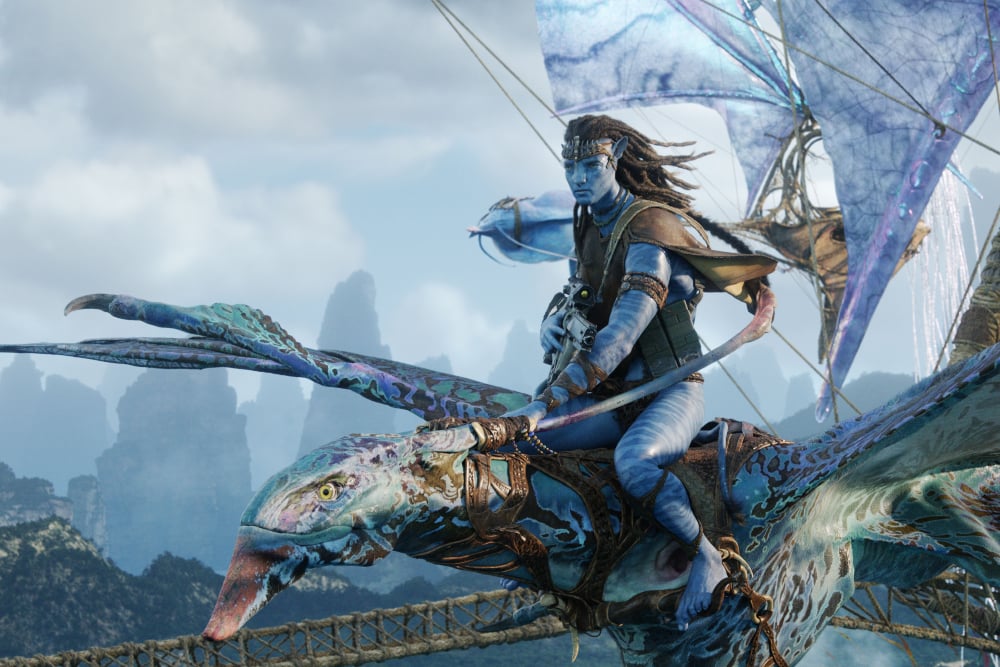
When James Cameron released “Avatar” in 2009 — his first film since the record-smashing “Titanic” — it represented a great leap forward in big-screen technology. Dazzling visual effects and a truly immersive use of 3D made it an unforgettable in-theater experience. Cameron waited 13 years to deliver a sequel, 2022’s “The Way of Water,” and he largely recreated the experience of viewing the first film; taking full advantage of technical advancements, the sequel was just as awe-inspiring as its predecessor.
Now, the third film, “Fire and Ash,” arrives just three years later — the blink of an eye in Cameron’s famously protracted filming schedule. Visual effects technology has undoubtedly improved in three years, but not markedly — and certainly not to the eye of the casual viewer. We can no longer say, “I’ve never seen anything like this,” as we could with the previous “Avatar” films; in fact, we have, just three years ago.
What’s left, then, is the unspoken reality of the franchise: The story and its characters were never all that compelling. And boy was this the wrong time to deliver an installment that relied heavily on that ho-hum plot.
Humans are still attempting to exploit the planet Pandora for its natural resources. Jake Sully (Sam Worthington), formerly a human who used advanced technology to be delivered into the body of a Na’vi, is still trying to rally the planet’s various tribes and species to unite and defend their homeworld. The Sully clan — mother Neytiri (Zoe Saldaña), a pair of biological children (Britain Dalton and Trinity Jo-Li Bliss), an adopted Na’vi (Sigourney Weaver) and a stray human (Jack Champion) — are also mourning the death of Jake and Neytiri’s oldest son, who didn’t make it through the culminating battle in “The Way of Water.”
Now, series heavy Col. Miles Quaritch (Stephen Lang) has formed an uneasy alliance with the embittered Mangkwan tribe, led by the sinister Varang (Oona Chaplin). These Na’vi, who live in the shadow of a volcano, want to conquer their world — a bellicose desire Quaritch is only too happy to exploit.
This thread is an alarming one in its symbology. The “Avatar” series is, by and large, about the sacred relationship between Indigenous populations and their land. Varang and the Mangkwan tribe, however, fall back on stereotypes from mid-century Westerns — specifically, those of the so-called “bad Indian” trope, in which certain tribes were depicted as more violent and hostile than others. The Mangkwan whoop, scalp and smoke ceremonial pipes; it is alarming and incongruous to see this franchise dabble in such hackneyed and harmful representation.
If we set that problem aside for a moment, “Fire and Ash” is a narrative mess. It only arrives at its central conflict — some business about the human Spyder learning to breathe on Pandora, thus establishing that humans could survive on the planet and thereby threatening a more full-scale invasion of Earthlings — after an hour of scene-setting. Ultimately, it downplays and discards that thread, opting to rehash the climactic battle from “The Way of Water.”
That fight is legitimately dazzling. It would’ve been just as effective, however, at the beginning of the film; it relies not at all on the two-plus hours of exposition and story that precede it.
“Fire and Ash” feels like a late season of a dense television drama, weaving in threads from prior installments and relying on audience buy-in. This film not only presumes we’re familiar with the story, but assumes we’re fond of it; that represents overconfidence on Cameron’s part. I understand why he has to believe we care about Jake Sully and not just the dazzling visuals; it was folly, however, to rely on that belief.
My Rating: 4/10
“Avatar: Fire and Ash” is now playing in theaters.