Dahn Memory Lane: Poets Capture Pittsburgh in Verse
Perhaps unsurprisingly, the writers, even those in different eras, focused on the city's gray skies.
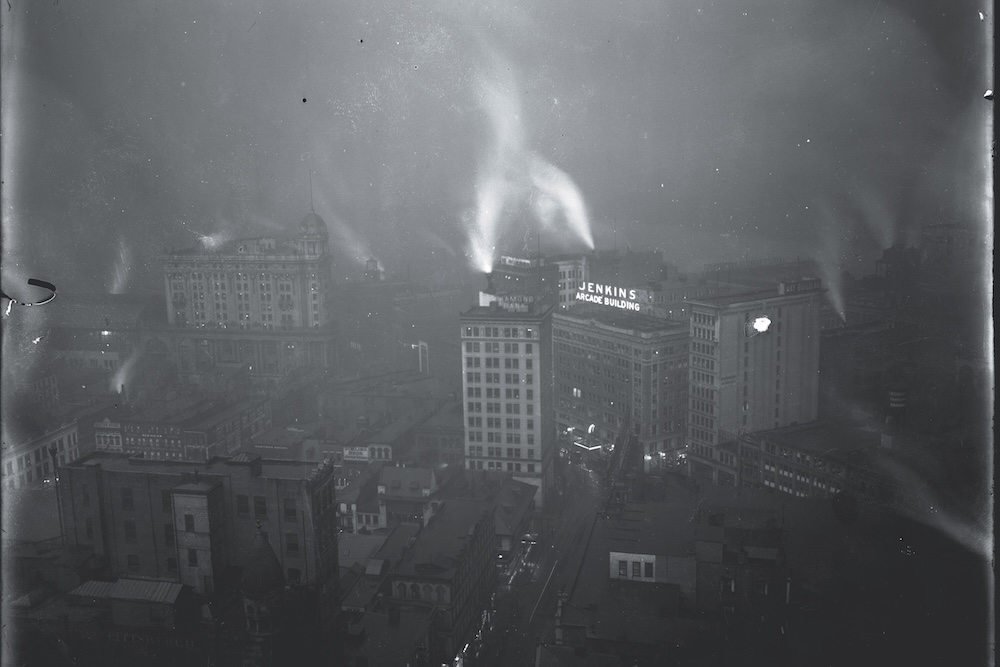
PHOTO: HEINZ HISTORY CENTER ARCHIVES
You’ve likely never heard of Dr. John D. Kelly or Professor Jim Daniels.
Poke about the dusty, deepest corners of your brain for some reference to them that you’ve perhaps forgotten and you’ll come up empty; John and Jim do not live there. Jim never met John. They never paired to make some astonishing scientific discovery.
John was already an established medical doctor by 1918, whereas Jim was a professor at Carnegie Mellon University in 1995. So, you see, far too many decades separated the apexes of their lives to place them in concert with one another.
Except in poetry. Poetry about Pittsburgh, specifically.
While John, our medical doctor, worked amid the choking industrial smoke of Progressive Era-Pittsburgh, Jim, our professor, was experiencing one of the city’s storied post-steel renaissances.
Amid two very different but similarly gray skies, they used their pen (or perhaps in Jim’s case, a cumbersome IBM Thinkpad) to ponder the air around them. Dr. John chose sturdy, reliable rhyme and repetition. Professor Jim arranged his words to snap, bite, entertain and retreat.
For John, it was skies painted black by industrial pollution that poured into Pittsburgh’s air unabated that led him to submit a poem to a medical journal in 1918.
Oh, Pittsburgh city, the city of smoke,
of soot and ashes that blacken and choke
Of furnace fires and chimneys tall
Vomiting smoke and soot o’er all,
Till the mud is black to the river’s brink
And the river flows like thickened ink.
For three stanzas the doctor marvels at the “soot on the grass, soot on the street/soot on the faces of all you meet.” This might be the most depressing Dr. Seussification of Pittsburgh ever.
For Jim in 1995, the air was much cleaner, but the stubbornly dismal weather we’re all too familiar with compelled the professor of English to pen “Pittsburgh Gray,” in which he muses, “The sensor on my flood lights/says it’s still dark/though it’s noon.” Later in the poem, he asserts,
If I was naming crayons
I’d call one Pittsburgh Gray.
I’d press on it hard.
I’d make a set of twelve,
one for each month:
the Pittsburgh Gray set.
July would be almost blue.
I don’t think even Bob Ross could create “happy little” anything with a set of Pittsburgh Gray crayons, even if one of them generously abutted the borders of blue.
John and Jim were not the first or only wordsmiths to wax poetic about Pittsburgh. At a time when pollution meant progress and fortune, poets often wrote romantically of the fiery nature of the Steel City.
In his 1868 poem entitled “Pittsburgh,” Civil War journalist George Alfred Townsend saw “monsters of steam,” “the wizard perspective of bridges” and “iron that melts for the dancing.”
Richard Realf, a brooding-eyed, modernly coiffed, magnetically handsome poet of the same era, published “Hymn of Pittsburgh” around 1875. To him, Pittsburgh was the son of Vulcan, the ancient Roman god of fire and forge, “strong-winged with steel” and the “monarch of all the forges.”
Realf’s poem saw Pittsburgh holding the hand of American industry while pulling the country toward a more glorious future, writing,
I fling the bridges across the gulfs
That hold us from the To Be,
And build the roads for the bannered march
Of crowned Humanity.
But for every poet who wrote romantically of forges lighting the night sky with the crimson fires of industrial wealth, there were others who fretted about industry’s impact on the environment and the laborer. In 1915, Madeleine Sweeny Miller did not see progress in the filth, but rather “rain full of smoke, air-bearing vapors that stifle and choke.” Just a few years later in 1919, poet William McFee wrote of Pittsburgh’s environmental damage,
See how the green has grown blackened and dead,
and the people faint in the soot-choked air;
see how the sky is a pall overhead,
A pall blood-red with the furnace flare.
The situation had not improved by 1929, when local student Eleanor Trott used her poem “Mill Town” to tell of hulking industrial monsters that “poured wastage” into the rivers. Other poets, such as James Oppenheim in 1925, worried for the steel laborer who “speeds his soul till his body wrestles with terrible tonnage and terrible time.” In 1912, LIFE magazine dedicated an entire issue to poking fun at Pittsburgh’s pollution, politics and people. A poem in that issue, “The Blast-Furnaces” by Deems Taylor, begins,
Sullen beneath its sooty skies,
Drugged with the fumes of gas and coke,
The sprawling, blackened city lies
Wrapped in its pall of smoke.
It ends with,
The toil we waste, the men we kill
Concern us not. We serve the will
Of him who made us — Man.
Oh, to have been in the room when Andrew Carnegie was handed that issue. Not every poet felt the need to take the city so seriously. A poem by Meda Logan that appeared on a local menu in 1907 reads,
Here’s to grim Pittsburgh
the city of smoke,
Where the sky’s but a memory
and sunshine a joke.
What a hurtful yet very valid burn. While poems about Pittsburgh’s industries, people and weather are plentiful, finding lyrical writings about our sports teams proved more difficult. I was therefore quite excited when I stumbled upon a Pirates poem from April 1973 in the Stamford Advocate. It was brief, but did include a photo as supporting evidence. The poet, former Pirates star outfielder Dave Parker. The poem: “If you hear any noise/It’s just me and the boys/Boppin”
I’ll snap for that.