“Keep Looking Up:” Finding Stories in Pittsburgh’s Antique Skyscrapers
Mark Houser’s window displays along Fourth Avenue Downtown are part of the city’s beautification efforts ahead of the 2026 NFL Draft.
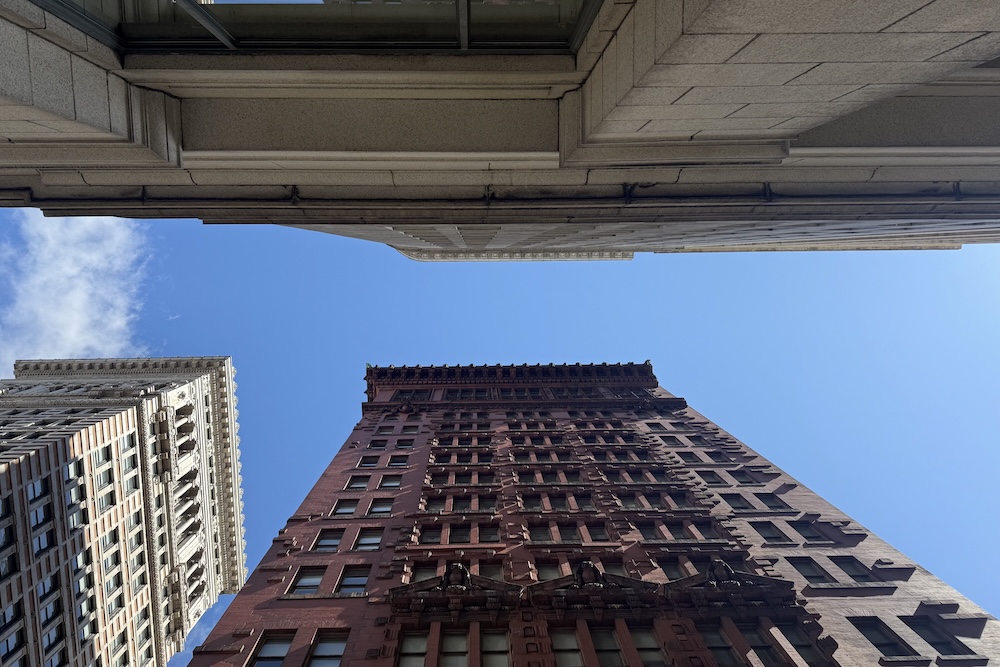
LOOKING UP AT FOURTH AVENUE’S SKYSCRAPERS | PHOTOS BY OLLIE GRATZINGER
Mark Houser’s mother once told him to keep looking up, and he hasn’t stopped since.
Houser, a journalist by trade and a “historian by temperament,” is the mind behind a new initiative to “redd up” Downtown ahead of the 2026 NFL Draft — all while educating passersby about the hidden history of Pittsburgh’s towering skyscrapers.
You may know Houser from his evocative Skyscraper Rooftop Views tours, held on a few select weekends each year (the next are June 20-21); from his books, which detail the transformative power of skyscrapers around the U.S. and capture the stories of the people who built and commissioned them; or from his contributions to Pittsburgh Magazine, where he has written extensively on the city’s history, landmarks and architecture.
More recently, you might’ve seen his work in the windows of select buildings along Fourth Avenue, which Houser calls “antique skyscrapers.”
The window displays on the Standard Life building, built in 1900, tell the story of “The Wall Street of Pittsburgh,” the Fourth Avenue stretch named for the sheer number of financial institutions that crowded the block in its heyday. The Pittsburgh Stock Exchange was even on the building’s second floor for two years before it moved to its new quarters down the street.
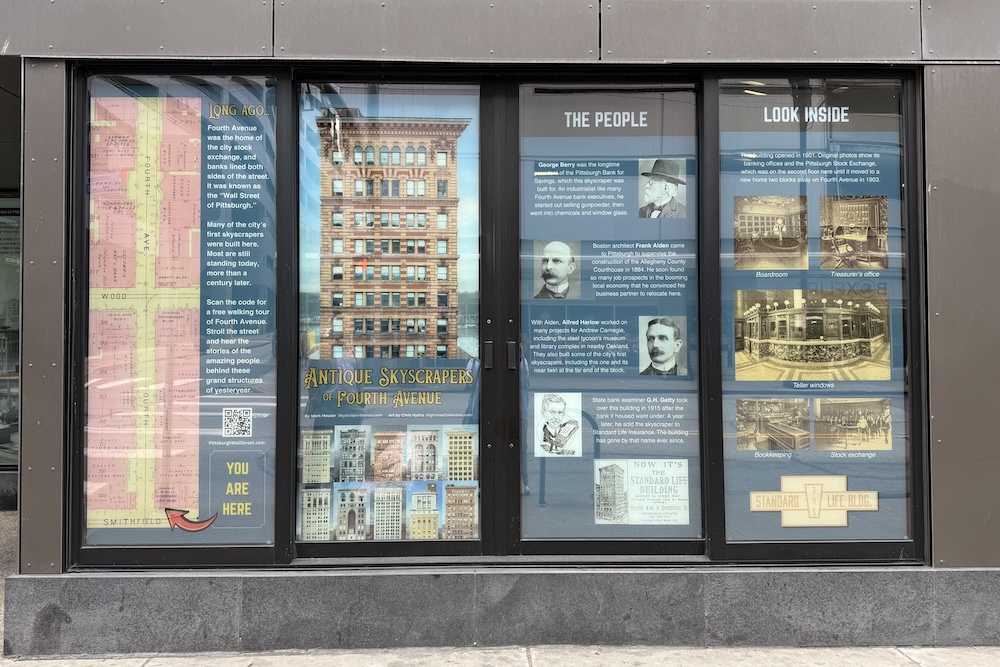
HOUSER’S WINDOW DISPLAYS AT THE STANDARD LIFE BUILDING
Displays can also be found in the lobby of the Arrott Building, which now houses the Industrialist Hotel; the LiveWell Building; and the YWCA at the corner of Fourth Avenue and Wood Street. The last, Houser says, is a collaborative project with architect Rob Pfaffmann, Benedum-Trees Gallery curator Erin O-Neill and the Pittsburgh Downtown Partnership.
Houser is currently working on displays for the Times Building, the circa-1892 skyscraper that became the first in the city built with a steel frame.
“I think it’s natural to ignore them, and they’ve been ignored for a long time, because they’re not as tall and they look old,” Houser says of the skyscrapers. “It’s easy to lose sight of the fact that when they went up… these things completely transformed the city. They were like dandelions coming up in April. There are people’s stories behind every one of them.”
To tell those stories, the displays incorporate historical images Houser found mostly in the Heinz History Center’s Detre Library and Archives, as well as photographs by Chris Hytha and a QR code folks can scan to learn more or take a walking tour of the corridor.
The photographs, shot by a drone, allow for a closer look at minute details that may be hard to spot from the ground, including the howling masks along the cornices of the Arrott Building and the 1855 $1 Liberty Gold Coin adorning Dollar Bank. The text, written by Houser, details information he garnered from old newspapers and historical documents.
“It’s partly to tell the stories of the people behind them, because each building is a statement of personal ambition,” Houser says. “There are great stories about people who were important to their city.”
The Arrott Building, the first true skyscraper to be designed by the famed architect Frederick J. Oesterling, was built in 1902 and commissioned by the Bathtub King of Pittsburgh, James Arrott, who built an empire out of iron-enameled bathtubs and housed it in the brick- and terracotta-striped highrise on Fourth Avenue.
Even though most Pittsburghers have likely never heard of the Bathtub King — and even though the Arrott Building is no longer the tallest on the block — the company he founded is still in business today as American Standard, and Arrott’s story remains a part of Pittsburgh’s bygone gilded age.
“There’s a striver behind that building, and usually they’re connected to why the city is what it is today,” Houser says. “They built up industries, took risks and they created something. Like that Bathtub King guy: Maybe we don’t know his story, but it’s there. He was important.”
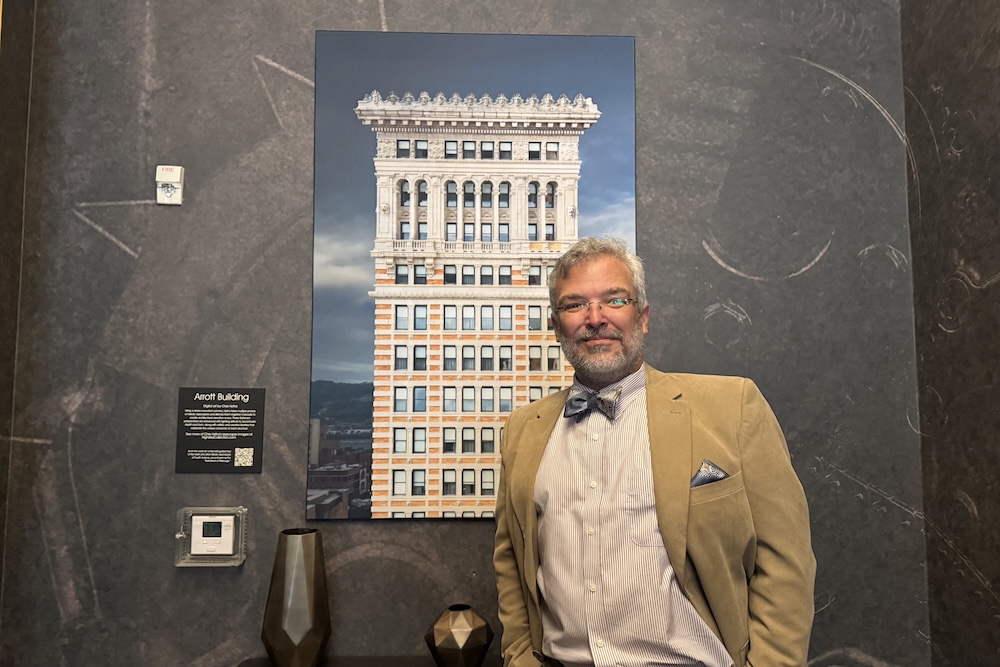
HOUSER POSING WITH HIS DISPLAY INSIDE OF THE ARROTT BUILDING
The window display project comes amid the city’s ongoing beautification efforts ahead of the 2026 NFL Draft, which have included trash-gathering “Immaculate Collection” events and a wide variety of pop-up shops to fill vacant storefronts. Houser first began working on the window project in early February with the Draft as its impetus, but says it’s something that can go on much longer, even after the much-anticipated event is over and done with.
“The sky’s the limit,” he says.
So far, the reception has been great. Houser says web analytics show more than 5,000 unique visitors — that is, folks who scanned the QR code on one of the three displays.
Ernie Miller, property manager of the Standard Trust building, says he often sees people outside looking at the displays, pointing to them and studying them.
“We get a lot of compliments, a lot of interactions, people taking pictures of them, reading them,” Miller says. “They’ve been a big hit.”
It’s something Houser hopes will continue to inspire visitors and locals alike to look up from time to time.
“I think if we want people to care about our city, we should share these stories so that these buildings aren’t just blank facades, but they are the story — a personal story of ambition and people that shape their city,” he says. “And, I think it makes us think a little bit about the legacies that we can leave behind.”
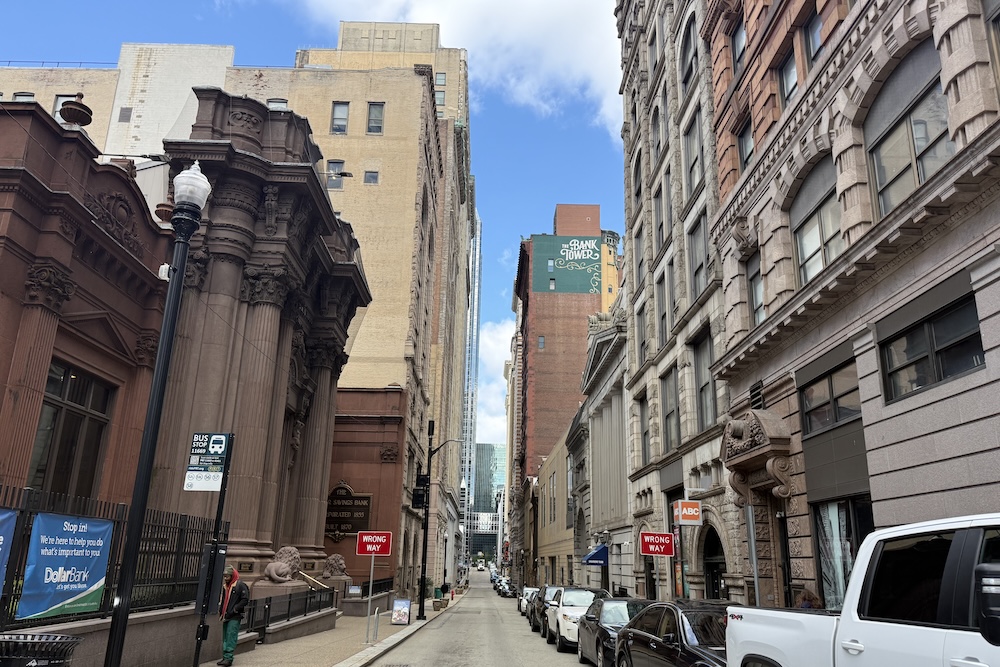
FOURTH AVENUE, WHICH WAS ONCE KNOWN AS THE WALL STREET OF PITTSBURGH