Which Pittsburgh Public Schools Are Closing?
The newly approved plan to close and consolidate district schools has not been popular among parents and students.
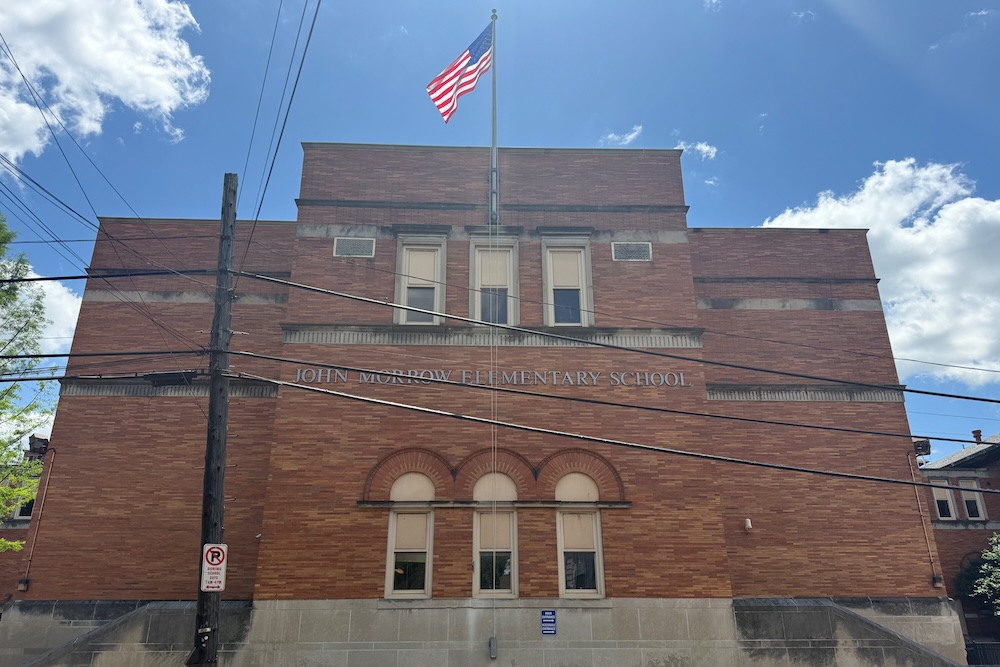
PHOTO BY OLLIE GRATZINGER | PITTSBURGH MORROW IN BRIGHTON HEIGHTS WILL SOON SERVE STUDENTS THROUGH FIFTH GRADE INSTEAD OF EIGHTH.
Pittsburgh Public Schools has announced a new plan that officials say will modernize the district and bring back neighborhood schools, but families and students aren’t so sure.
The district’s Board of Public Education voted on May 27 to close 12 area schools and nine facilities over the next couple of years as part of its new “Future-Ready Facilities Plan.”
In a letter sent out to PPS families and staff, officials say the plan will “modernize learning environments, improve long-term sustainability and expand equitable access to high-quality academic programming, extracurricular opportunities and student supports.”
Phase One of the plan, which will take effect at the start of the 2027-28 school year, includes preliminary school closures and a handful of relocations. It will also see a significant change to the district’s feeder patterns, which determine which schools serve which students in which neighborhoods.
School closures include:
- Allegheny 6-8
- Arsenal PreK-5
- Fulton PreK-5
- King PreK-8
- Linden PreK-5
- Manchester PreK-8
- Miller African-Centered Academy PreK-5
- Milliones 6-12
- South Brook 6-8
- South Hills 6-8
- Spring Hill K-5
- Woolslair PreK-5.
Morrow in Brighton Heights will also lose its 6-8 configuration and become a K-5 school. Allegheny K-5 will move to the King building, and Schiller 6-8 will move to the Allegheny building.
Facilities closures include Baxter, Friendship, Fulton, Manchester, McKelvey, Mirror Primary, Schiller, Spring Hill and Woolslair.
The district will also open two new schools: Northview PreK-5 and SciTech 6-8, as well as an early childhood center at the Allegheny Annex.
The Future-Ready Facilities Plan also involves a reimagining of the district’s magnet program and school configurations; currently, the district operates five different configurations: PreK-5, PreK-8, 6-8, 6-12 and 9-12. When the plan takes effect starting in the 2027-28 school year, the district will operate with only three configurations — K-5, 6-8 and 9-12.
“The approval of the Future-Ready Facilities Plan represents a transformational investment in the future of our students, schools, and communities,” superintendent Wayne N. Walters says in a statement. “This plan is about far more than buildings. It is about creating equitable opportunities, strengthening academic experiences, and ensuring every student has access to learning environments that support success in college, career and life.”
Officials add that the plan addresses long-standing challenges related to declining enrollment and aging infrastructure by aligning resources with student needs through school consolidations, new school openings, grade-level reconfigurations and investments in modernized facilities. It is designed to create more equitable and consistent student experiences while generating approximately $4 million in savings in 2027 and approximately $8 million in savings in 2028 — the first full year of implementation, supporting future investments in academic initiatives and student supports.
However, the response from PPS families has been mostly negative. Many argue that the plan is just a thinly veiled effort to save money, that the district won’t deliver on its promises of equity and that students won’t actually see any benefit from this type of restructuring.
At the meeting where the plan’s approval was announced, one parent interrupted the voting process to share her anger and disappointment in the board’s decision, WESA reports. The parent was removed from the building, but not before telling the board it should be ashamed for moving forward with the plan despite significant and consistent community resistance.
Many parents and community members have also taken to social media to express distrust of the district’s board, many members of which are new, and their anger about a plan that will ultimately send most of their children elsewhere for school.
Indeed, WESA reports that even with the schools closed and consolidated, the financial gains resulting from the plan won’t last long: the district’s balance will still dip into the red by the end of 2028. The district’s own budget book shows that it has been operating at an annual deficit greater than the $7-8 million the consolidation plan is expected to generate.
“This sucks. Some of the people voting yes were literally just elected and didn’t even sit through a community engagement session,” one Facebook user commented on a post by Pittsburgh Public Schools announcing the closure. “There was very little real community input. This could’ve been a much, much better plan. I’m scared to see how it is implemented.”
Another Facebook user commented on the positive tone of the district’s post, which features a young girl giving a thumbs up and a graphic with a large checkmark that reads, “Plan Approved!” The commenter accuses the district of inappropriately celebrating something that is not a win.
“Closing schools should not be framed as a victory for anyone,” the comment reads.
Another agreed, writing, “Don’t celebrate like it’s a win. Distasteful.”
On Pittsburgh’s subreddit page, the tone was the same. Users pointed out that Bloomfield is losing three of its schools, and North Side is losing both the elementary school in Spring Hill and the Montessori magnet in Troy Hill, as well as Morrow 6-8, Manchester PreK-8 and Allegheny 6-8. While the district has said it wants to bring more students back to their feeder, or neighborhood, schools, many of the closures and consolidations will have students traveling farther for their “home” schools.
“Yeah, this sucks,” writes one Reddit user on the Pittsburgh subreddit. “I live in Lawrenceville and the 3 elementary schools closest to us are closing … I think public education is such an important way to provide opportunities for everyone and it’s really disappointing to see it dismantled like this. We are planning to have kids and now we’ll have to decide whether to move or send them to a private/charter school because nothing else will be left in our community.”