Map: Everything You Need to Know About Pittsburgh’s Hidden Histories
Think you know Pittsburgh history? Look inside for a deep dive into some of the people and places that made our city great.
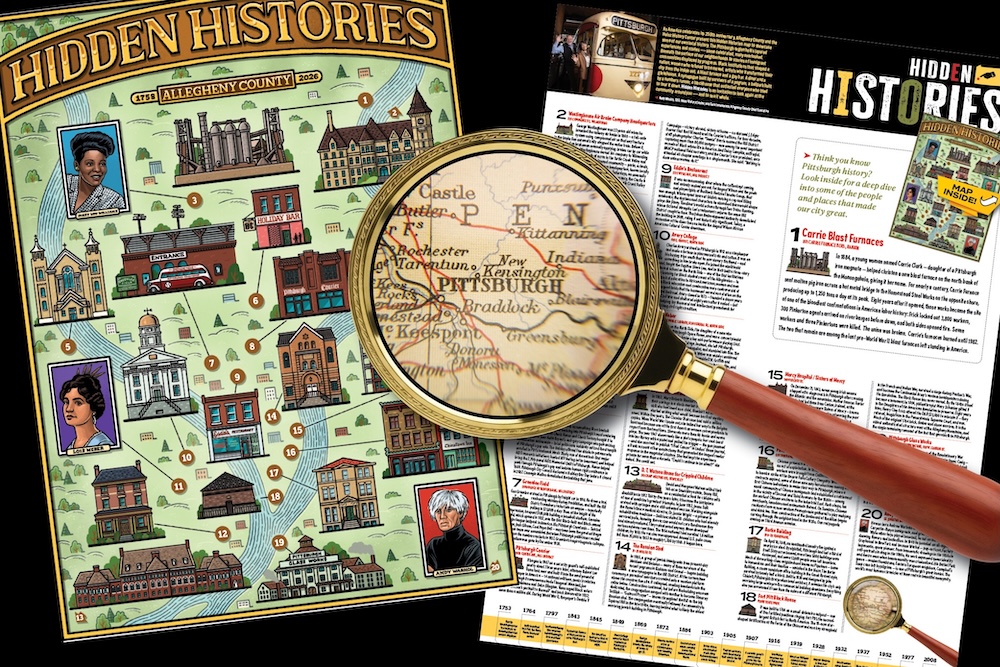
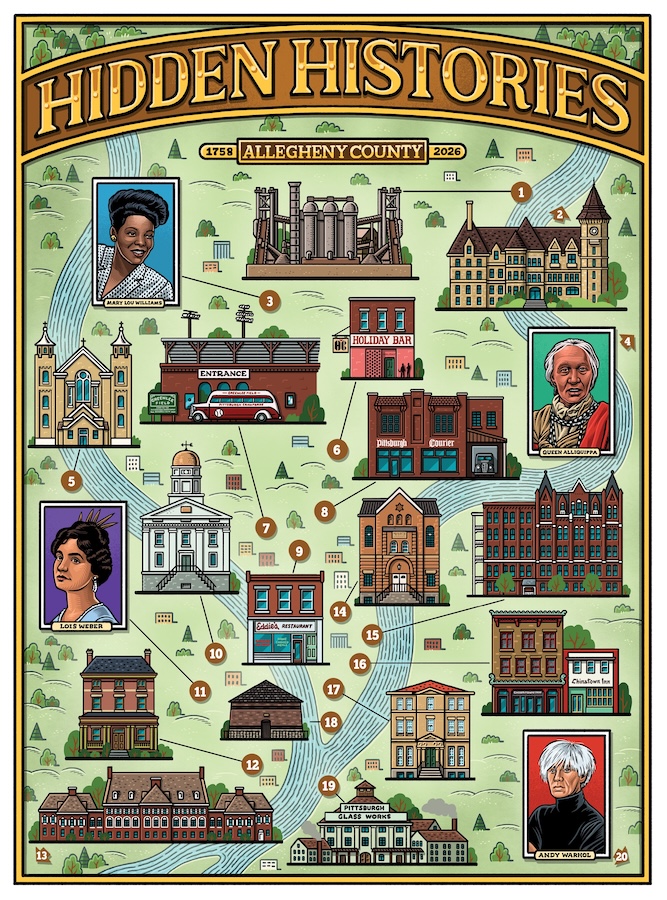
Pittsburgh has always been a city of layered histories — some celebrated, many overlooked. Beneath the surface of its neighborhoods lie stories of immigrant communities displaced by progress, Black institutions that shaped a nation, women who refused to be moved, artists who transformed their city from the inside out. A blast furnace and a gay bar. A diner and a glasshouse. A synagogue built by survivors of a pogrom, a ballpark built by a numbers runner, a blockhouse that outlasted everyone who tried to tear it down.
As America celebrates its 250th anniversary, our commemorative Hidden Histories map is an invitation to look again at the city around you — and to see it whole.
For a free download of our exclusive Hidden Histories map, visit here.
(1) Carrie Blast Furnaces
801 Carrie Furnace Blvd., Rankin
In 1884, a young woman named Carrie Clark — daughter of a Pittsburgh iron magnate — helped christen a new blast furnace on the north bank of the Monongahela, giving it her name. For nearly a century, Carrie Furnace sent molten pig iron across a hot metal bridge to the Homestead Steel Works on the opposite shore, producing up to 1,250 tons a day at its peak. Eight years after it opened, those works became the site of one of the bloodiest confrontations in American labor history: Frick locked out 3,800 workers,
300 Pinkerton agents arrived on river barges before dawn, and both sides opened fire. Seven workers and three Pinkertons were killed. The union was broken. Carrie’s furnaces burned until 1982. The two that remain are among the last pre–World War II blast furnaces left standing in America.
(2) Westinghouse Air Brake Company Headquarters
325 Commerce St., Wilmerding
George Westinghouse was 22 years old when he invented the railway air brake in 1869 — a fail-safe system using compressed air so that any fracture in the brake line automatically stopped the entire train. Before it, trains relied on brakemen manually applying brakes car by car while accidents piled up. Westinghouse moved his company to Wilmerding in 1889, purchasing hundreds of acres in the Turtle Creek Valley and building not just a factory but a planned community — parks, schools, a hospital, and this turreted Romanesque headquarters, known locally as the Castle. He gave workers half-days on Saturdays, an unusually progressive policy for the era. After decades of vacancy, the Castle is now home to the Westinghouse Arts Academy and Turtle Creek Valley Arts — industry giving way, at last, to creativity.
(3) Mary Lou Williams
Lincoln Elementary School, 328 Lincoln Ave.
She came to Pittsburgh as a small child, the daughter of an Atlanta family that had moved north seeking a better life. When her Black family arrived in East Liberty, the neighbors threw bricks at their house — until they heard Mary Lou play the piano. The harassment stopped. By her teens, Pittsburgh was calling her “the little piano girl of East Liberty,” and she was already a professional musician helping support her large family. She wrote arrangements for Duke Ellington and Benny Goodman, then mentored virtually the entire bebop generation — Thelonious Monk, Charlie Parker, Dizzy Gillespie, Miles Davis — from her New York apartment, which musicians treated as an always-open refuge. She attended Lincoln School, just up the hill, from 1919 to 1923.
(4) Queen Aliquippa
McKeesport area History knows her only through the eyes of men who called her “queen” — a colonial title the British bestowed on powerful Native leaders. In her own world, she was a clan matron, acting chief and diplomatic leader among the Seneca-Mingo communities of the Ohio Country, wielding enough influence that the French commander Pierre Joseph Céloron de Blainville noted in 1749 that this “old woman devoted to the English” considered herself sovereign over her town. She was right to be offended when the 21-year-old George Washington bypassed her village on his mission north to confront the French. He had to double back. His journal records the visit with characteristic economy: “I made her a present of a match coat; and a bottle of rum, which was thought much the better present of the two.” She died in 1754, driven east by the war she had helped shape.
(5) Maxo Vanka Murals
St. Nicholas Croatian Catholic Church, 24 Maryland Ave., Millvale
The commission was unusual from the start. Maxo Vanka, the Croatian artist hired to paint the walls of St. Nicholas in 1937, was not a practicing Catholic — he held fiercely antiwar and pro-worker views, and was married to a Jewish American woman. The priest gave him unusual latitude: half the murals religious, the other half his own inspiration. Vanka worked in marathon overnight sessions, eating little, drinking much coffee, and reportedly seeing a ghost. What he left on these walls is staggering — a Croatian mother weeping over her son killed in a Johnstown mine, a soldier plunging a bayonet into a crucified Christ, the Virgin Mary snapping a rifle on a battlefield, a tycoon feasting while a beggar starves. Time magazine called it one of the finest sets of church murals in America. Some locals call it Pittsburgh’s Sistine Chapel.
(6) The Holiday Bar
4620 Forbes Ave., Oakland
It started in the early 1960s as something like a beatnik coffeehouse before evolving into Pittsburgh’s most enduring gay bar. When Chuck Honse and Chuck Tierney bought it in 1977 — the same year Anita Bryant’s anti-gay campaign was galvanizing communities nationwide — local politicians suddenly noticed the strength of Pittsburgh’s gay vote. The Holiday offered free drinks to patrons who enrolled in Pitt’s landmark Men’s Study, one of the nation’s first major AIDS research initiatives; hosted HIV testing in the basement; and helped bring the 2,700-panel AIDS Memorial Quilt to Pittsburgh. Honse helped push through Pittsburgh’s gay and lesbian human rights ordinance in 1989. Pittsburgh City Council declared a Holiday Bar Day before it closed in 2007. Carnegie Mellon demolished the building that June.
(7) Greenlee Field
2500 block of Bedford Ave., Hill District
Gus Greenlee arrived in Pittsburgh by freight car in 1916. He drove a taxi, ran bootleg whiskey during Prohibition, and built the Hill District’s numbers racket into an empire — reportedly pulling in $25,000 a day. Then, at the height of the Depression, he spent $100,000 building a baseball stadium. Greenlee Field, which opened in 1932, was the first Black-built and Black-owned major league ballpark in America. His Pittsburgh Crawfords — Satchel Paige, Josh Gibson, Cool Papa Bell — may have been the greatest Negro League team ever assembled. But when Pittsburgh politicians cracked down on the numbers rackets in 1937, Greenlee’s empire began to collapse. The stadium was gone by December 1938.
(8) Pittsburgh Courier
2628 Centre Ave., Hill District
It began in 1907 as a security guard’s self-published poetry sheet. Three years later, attorney Robert Lee Vann took over and built it into the most powerful Black newspaper in America — 14 national editions, peak circulation 400,000. Through its newsroom strode Thurgood Marshall, Joe Louis, Jackie Robinson and Duke Ellington. Vann urged Black voters to “turn Lincoln’s portrait to the wall” and back Roosevelt in 1932; more than a million did. During World War II, the paper’s Double V Campaign — victory abroad, victory at home — so alarmed J. Edgar Hoover that the FBI monitored the Courier’s offices. For four decades, staff photographer Charles “Teenie” Harris roamed the Hill District capturing more than 80,000 images — now among the most important records of Black urban life in America. And Daisy Lampkin, suffragist, NAACP national field secretary, and the Courier’s vice president, once attended 40 chapter meetings in a single month. She said: “Nothing is done unless women do it.”
(9) Eddie’s Restaurant
2172 Wylie Ave., Hill District
It was an unassuming diner where the coffee kept coming and nobody rushed you out. For August Wilson and the poets and playwrights of the Black Horizon Theatre Group, that was enough. Wilson spent hours at Eddie’s nursing a cup and filling notebooks; the rhythms and characters he absorbed there would shape plays like Jitney. The diner’s world echoes through Two Trains Running, whose fictional Memphis Lee’s restaurant conjures the same Hill District caught in time. The Urban Redevelopment Authority demolished the building in 2008, ruling it not historically significant. Today, a recreation of the diner lives on inside the August Wilson African American Cultural Center downtown.
(10) Avery College
616 E. Ohio St., North Side
Charles Avery arrived in Pittsburgh in 1812 as a shopkeeper and made a fortune in pharmaceuticals and cotton. It was on his buying trips south that he saw slavery firsthand — and something in him broke open. He joined the abolitionist movement, fought the Fugitive Slave Law, and in 1849 built a three-story Greek Revival school on the North Side — one of the first institutions of higher learning for Black students west of the Alleghenies — to offer a classical education to African Americans, women and men alike. Both Black education and coeducation were controversial at the time. Legend holds that the basement served as a station on the Underground Railroad. Avery closed in 1873 — founded a dozen years before the Civil War and shuttered eight years after it ended — but not before helping lay the moral and intellectual groundwork for Pittsburgh’s long civil rights tradition.
(11) Lois Weber
Carnegie Public Library, 1230 Federal St., North Side
She grew up on the North Side, the daughter of a man who decorated the Pittsburgh Opera House, and was a concert pianist by sixteen — until she broke a key mid-performance playing Liszt. She never returned to the concert stage. Instead, she left Pittsburgh, lived in poverty as a street-corner evangelist, and stumbled into film. The stumble changed cinema. In her time, Lois Weber was widely considered one of early Hollywood’s great directors alongside D.W. Griffith and Cecil B. DeMille — the first American woman to direct a feature film, and by 1916 one of Universal’s highest-paid directors. She used that power to make movies about birth control, abortion, capital punishment, and poverty. Pennsylvania banned her film Where Are My Children? as unfit for decent people. It became one of Universal’s biggest hits of the year.
(12) Mary Roberts Rinehart
954 Beech Ave., North Side
In 1903, Mary Roberts Rinehart and her husband lost their savings in a stock-market crash. Returning to a skill she had loved as a child, Rinehart sat down and started writing what would become her first mystery novel. Within five years, The Circular Staircase had sold a million copies. When World War I broke out, she talked her way to the Belgian front and became one of the first American women correspondents to report from the front lines. She wrote more than 60 books and seven plays. The year 1947 alone reads like a plot synopsis: her cook burst into her library with a pistol and pulled the trigger — the gun jammed — and she survived to publish “I Had Cancer” in Ladies’ Home Journal, a frank account of her mastectomy that generated the largest reader response in the magazine’s history. She had kept the experience private for more than a decade. “Could I continue to be silent?” she asked. She could not.
(13) D. T. Watson Home for Crippled Children
301 Camp Meeting Rd., Sewickley
David and Margaret Watson willed their 140-acre Sewickley estate, Sunny Hill, as a residential school for children with disabilities in 1917. Thirty-five years later, it became the birthplace of one of medicine’s greatest triumphs. In June 1952, Jonas Salk arrived with syringes and a still-untested vaccine. Working alongside the Home’s fierce medical director, Dr. Jessie Wright — a pioneer in rehabilitation medicine — Salk inoculated 30 children who had already survived polio, knowing the vaccine would not cure the disease they had already endured. They volunteered anyway. None developed serious adverse reactions. The 1954 national trial enrolled 1.8 million children; by 1955 the vaccine was approved. Annual U.S. polio cases fell from 35,000 in 1953 to roughly 1,300 by 1961. It began here.
(14) The Russian Shul
21–23 Miller St.
In 1905, a group of Jewish immigrants from present-day Moldova and Belarus — many of them survivors of the recent pogroms in Kishinev and Gomel — began building a new synagogue in the Hill District. At the cornerstone ceremony, a parade of marchers crowded onto a wooden platform above the construction site. It collapsed, sending hundreds into the cellar below. Construction continued, but before the building was even dedicated, the congregation merged with another to become Shaaray Tefillah — “Gates of Prayer” — known throughout the Hill as the big Russian shul. The congregation eventually followed its community to Squirrel Hill in the late 1940s, leaving behind what is likely the oldest surviving Jewish building in Pittsburgh.
(15) Mercy Hospital / Sisters of Mercy
1400 Locust St.
On December 21, 1843, seven young Irish women stepped off a stagecoach in Pittsburgh after crossing the Atlantic and the mountains. Mother Frances Xavier Warde had led them from Carlow, Ireland, at the invitation of Pittsburgh’s bishop. They were Sisters of Mercy — known as “the walking Sisters” for their unusual practice of serving the poor directly in the streets. Within days they had opened a school in a convent basement. In 1847 they opened Mercy Hospital in a downtown concert hall, welcoming patients regardless of religion and serving rich and poor alike. The first patient was a sick sailor from a riverboat. During a typhus epidemic, four sisters died caring for the afflicted. It was Pittsburgh’s first hospital and the world’s first Mercy Hospital. From Pittsburgh, the order expanded across much of the American frontier.
(16) Pittsburgh’s Chinatown
520 Third Ave.
Chinese presence in Western Pennsylvania began with an act of exploitation. In 1872, roughly 300 Chinese workers were brought from California and New Orleans to break a strike at the Beaver Falls Cutlery Company. When their contracts expired, some of these men may have become among the first Chinese individuals to make their way to Pittsburgh, where a small community of Chinese immigrants had established a settlement in the vicinity of Second and Third Avenues by the 1880s — among the earliest Chinese enclaves in the industrial East. Herb shops, tea merchants, laundries and restaurants thrived. On Sundays, Chinese residents from across western Pennsylvania gathered to play mahjong and drink tea. Then construction of the Boulevard of the Allies began carving through the neighborhood in the 1920s. One red pagoda awning on Third Avenue remains.
(17) Burke Building
209–211 Fourth Ave.
On April 10, 1845, an unattended laundry fire ignited a nearby ice shed. By nightfall, Pittsburgh had lost a third of itself. Sixty acres burned, more than 1,000 buildings were destroyed, and some 12,000 people were left homeless. Much of the working-class neighborhood known as Pipetown — home to ironworkers and their families — vanished in the blaze. The Burke Building, a cream sandstone office building in the Greek Revival style, survived by barely half a block. Built in 1836 and designed by John Chislett, Pittsburgh’s first professional architect, it remains the city’s only surviving large-scale pre-fire commercial building downtown. Everything else you see around it rose from the ashes of a different Pittsburgh.
(18) Fort Pitt Block House
Point State Park
It was built in 1764 as a small defensive outpost — one of five fortified positions ringing Fort Pitt, the second-largest British fort in North America. The 18-acre star-shaped fortification at the Forks of the Ohio served as a key stronghold in the French and Indian War, survived a siege during Pontiac’s War, and became the Continental Army’s western headquarters during the Revolution. The Block House has never moved. By the 1840s it had become a tenement. In 1894, philanthropist Mary Schenley gifted it to the Daughters of the American Revolution to preserve. Eight years later, Henry Clay Frick offered the DAR $25,000 to relocate it — they refused, fought him to the Pennsylvania Supreme Court, and won. Much of the original 1764 brick, timber and stone survives. It is the oldest authenticated structure west of the Allegheny Mountains, and the single remaining remnant of the fort that gave birth to Pittsburgh.
(19) Pittsburgh Glass Works
Foot of Duquesne Incline, 1197 W. Carson St.
In 1797, two veterans of the Revolutionary War — General James O’Hara and Major Isaac Craig — built a small frame glasshouse on the south bank of the Monongahela and began making window panes and bottles. It was a modest beginning, but with one innovation that mattered: they pioneered the use of coal-fired glassmaking in America, turning Pittsburgh’s most abundant resource into a competitive advantage. Their early advertisements offered window glass “of any size,” along with pocket flasks, pickling jars, and apothecary bottles for a nation moving west and needing everything. By the 1870s Pittsburgh had 46 glassworks and 6,000 workers in the trade. By 1902, Pittsburgh-area factories produced roughly half of all American glass. It started here, in a frame building with an eight-pot furnace.
(20) Andy Warhol
St. John the Baptist Byzantine Catholic Cemetery
He was born Andrew Warhola in Pittsburgh in 1928, the son of Carpatho-Rusyn immigrants, and grew up poor in Oakland. While other boys played baseball, he sat on the front stoop drawing flowers and butterflies. In 1949 he boarded an all-night Greyhound to New York and became Warhol — pop-art icon, Factory impresario, queer pioneer. From homoerotic drawings in the 1950s to self-portraits in drag in the 1980s, his work expressed queer identity and desire even when homosexuality was criminalized. His Bethel Park grave — modest headstone, Eastern European neighbors, Campbell’s Soup cans left by pilgrims — is one of Pittsburgh’s great ironies. The world’s most famous chronicler of fame rests in beautiful anonymity.