Dahn Memory Lane: Why Pittsburgh Needs To Be ‘The City of Champions’
Columnist Virginia Montanez explains that the city’s connection with its sports teams is more than mere fandom — it’s a relationship forged during Pittsburgh’s darkest days.
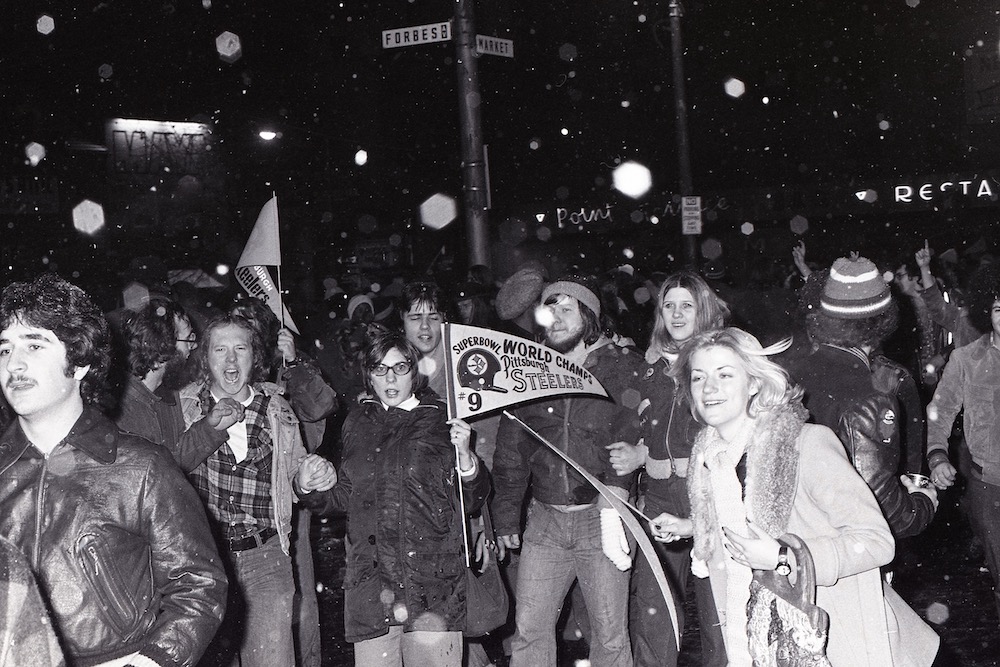
FANS CELEBRATE DOWNTOWN IMMEDIATELY AFTER THE STEELERS’ VICTORY AT SUPER BOWL IX. | PHOTO BY ANTHONY KAMBIC PHOTOGRAPHS, PSS 30, DETRE LIBRARY AND ARCHIVES
In a classic Pittsburgh wood-paneled basement, in my early 20s, I found myself letting a young man down easy. Bill. A friend who wanted to be more than a friend. It was the worst of cliches. “It’s not you. It’s me.” I said, “Let’s stay friends. I’m really sorry.”
Despite being born … nay, indoctrinated and baptized into black-and-gold culture from birth, nothing prepared me for Bill’s reply. “Aww, I’ll be all right,” he said sheepishly. “Steelers season starts next week.”
I held in a chuckle and told my ego that he was just floundering in an awkward moment. I’ve recounted that story a number of times across the years in the vein of “Steelers fans do be crazy.” I’ve come to recognize something deeper, however — something profoundly honorable and historical backlighting his response.
In this age of quick takes and quippy dismissals, non-sports fans like to assert their apathy about the fevers that infect local fanbases with one word: “sportsball.” Their intent is unmistakable: I can’t even be bothered to care, much less to specify which particular ball is involved. I am above such trivial matters.
The historical context of our perpetual obsession with our teams, in particular the Steelers, reveals why Pittsburgh’s fandom, rabid as it is, should be esteemed as a venerable artifact, for its roots are planted in a desperate search for comfort and pride amid the long collapse of the substance that formed our very identity: steel.
Prior to the Pirates’ World Series win of 1971 and the Steelers’ first Super Bowl run of 1974, there was little the world associated with Pittsburgh beyond smoke and mills. Our 1960 World Series win and Jonas Salk’s vaccine triumph in the 1950s were notable, but they did little to dispel the stubborn view that Pittsburgh was only a steel town. Pollution. Dilapidation. Miserable vistas. A startling lack of culture and class. Harsh edges of blue-collar roughness tainting everything from dress to speech. This perception was tolerable so long as the city could revel in the glory and riches that came alongside our steel fortunes.
But the steel industry had begun to shrink by the 1970s, just as our sports glory began to emerge. The Steelers’ first Super Bowl win on Jan. 12, 1975, came after 42 years of football frustration. More than that, it arrived 15 years after the region’s steel ingot capacity reached its peak. The ensuing erosion of the industry in the 1960s spread a palpable cloud of unease across Pittsburgh.
Against this backdrop, the 1974 Steelers whipped Pittsburgh into a black and gold frenzy on their way to Super Bowl IX. A local news video of ecstatic fans, some in classic tossle caps, singing the “We Got a Feeling” chant in sturdy Pittsburgh accents should not be separated from the economic climate within which it was filmed. The city needed a win in more ways than one.
As the game clock ticked to zero and the streets of downtown began to throng with raucous elation that would carry into the morning hours, linebacker Jack Ham was overheard in the locker room in New Orleans, musing, “The ’Burgh must be in ashes.” But reality waited in the wings. Just two days later, U.S. Steel announced the layoff of 1,300 steelworkers at the Duquense, Homestead, McKees Rocks and Irvin plants.
This downturn in steel production and jobs would be sustained into and beyond the team’s win against the Dallas Cowboys the following year at Super Bowl X. As Pittsburgh Post-Gazette staff writer Douglas Smock wrote in 1977, “The dark cloud that often hovers over the Pittsburgh area’s old steel mills is more than just smoky residue these days, as steelworker job cuts multiply.” He quoted a Homestead steelworker’s wife, who fretted, “It’s so shocking. I’m just petrified. We’re just waiting for something to happen to us.”
By the time the Steelers entered the 1978 season, which would culminate in their third Super Bowl, that something had indeed happened — and it was no longer an easily dismissable sense of foreboding hinting at a scary future.
The scary future had arrived at the door. The bottom had fallen out.
In late 1979, U.S. Steel announced it was phasing out operations at 16 facilities, which would toss 13,000 out of work in what U.S. Sen John Heinz referred to as a “tragic and crushing” blow. The very day the Steelers were clinching the division title in December, steelworkers were offering wage freezes in order to keep their plants open. Ten days after the Steelers beat the Los Angeles Rams at Super Bowl XIV, U.S. Steel announced a record quarterly loss.
Amid such pain, could anyone even care about sportsball? Oh, yes.
Through its sports teams, Pittsburgh showcased itself as more than just hell with the lid taken off. More than just the polluted city that Frank Lloyd Wright once recommended be abandoned. Sporting glory was the bridge to Pittsburgh being appreciated for more than its past. Pittsburgh Press columnist Roy McHugh noted this connection the day before the Super Bowl in 1980, writing of the city’s unappreciated assets, “You can walk the streets at night; we have a symphony, a ballet, public theater, museums, art galleries. All this and the Steelers, too.”
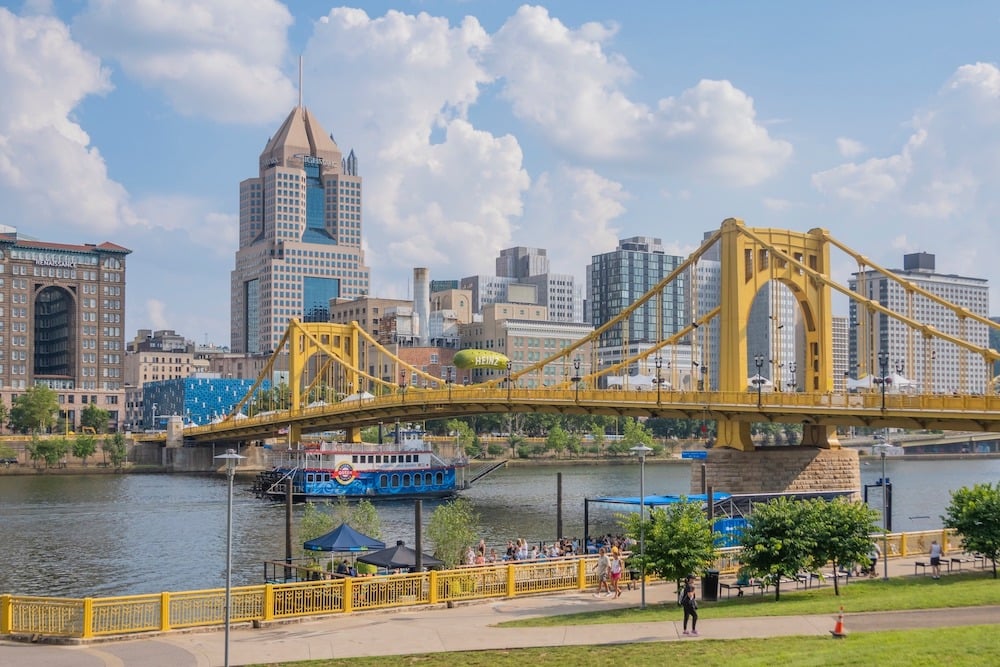
In 1975, an interviewer with Playboy magazine advised Terry Bradshaw that he’d enjoy greater fame playing for a more “glamorous” city. Bradshaw told the interviewer to look out the window onto Pittsburgh and tell what he saw. “Murky steel mills and green water,” came the reply. But Bradshaw, suddenly defensive, pointed out more. “I see the stadium. I see a barge … There’s the Clark candy bar company on the hill. That pretty bridge. The hillside. Hey, what better view could you want? How much more glamorous can a city get?”
In an NFL film from the 1979 season, Steeler fans are celebrating a playoff victory at a local dive when an older woman, surrounded by blue-collar yinzers, says earnestly to cheers, “It’s the greatest thing ever. It’s done so much for Pittsburgh, for the sports fans … see, we’re greater than just millworkers; there’s more than that to Pittsburgh, right?”
Sports also provided a welcome distraction from the city’s woes. In January 1980, a local financial expert opined that fans found the space to care deeply about the Steelers amid mill closings, rising prices and economic pain, because, “[while fandom] doesn’t help them meet their mortgage payments … it helps them handle all those things.”
In 1979, Pittsburgh earned a new identity: the City of Champions — a name coined that October by legendary sports broadcaster Howard Cosell when the Steelers defeated New England in overtime on Monday Night Football as the Pirates were playing in the World Series. Pittsburgh quickly adopted the new name as the focal point of our post-steel identity. After the World Series win, Willie Stargell told the world of that city they understood only as smoke and loss, “This is a city of nothing but champions.”
Finding a new home for collective pride catalyzed Pittsburgh toward rebirth in more ways than one. Then-mayor Richard Caliguiri explained, “The success of the sports teams has created an attitude, a spirit of accomplishment, and people are bolstered by it. They believe we can get things accomplished here.”
Yes, winning matters — mattered — but we shouldn’t dismiss our modern sports culture as merely the product or barometer of victories. History requires we look at the full contextual tapestry, and for Pittsburgh, that context was fear, pain and an uncertain path forward. Pittsburgh found her pride and found her way to renaissance and rebirth. We were able to do so because our 1970s sports teams used the bonds of collective elation to cement themselves into our soul and shore us up just as we were ready to crumble.
Bill and I didn’t stay friends, but I hope he knows that I know now: He wasn’t being immature or flippant when he looked to a fresh Steelers season for comfort. History tells us our sports culture is more than sportsball. It’s a tradition steeped in both pain and hope.
We’d do well to remember that, and honor it. Play “Renegade.”
In her column, Virginia Montanez digs deep into local history to find the forgotten secrets of Pittsburgh. Sign up for her email newsletter at: breathingspace.substack.com.