Dahn Memory Lane: What Did Harry Houdini Have to Do with Pittsburgh?
The legendary illusionist made it his mission to expose fraudulent Spiritualists, particularly in the Steel City.
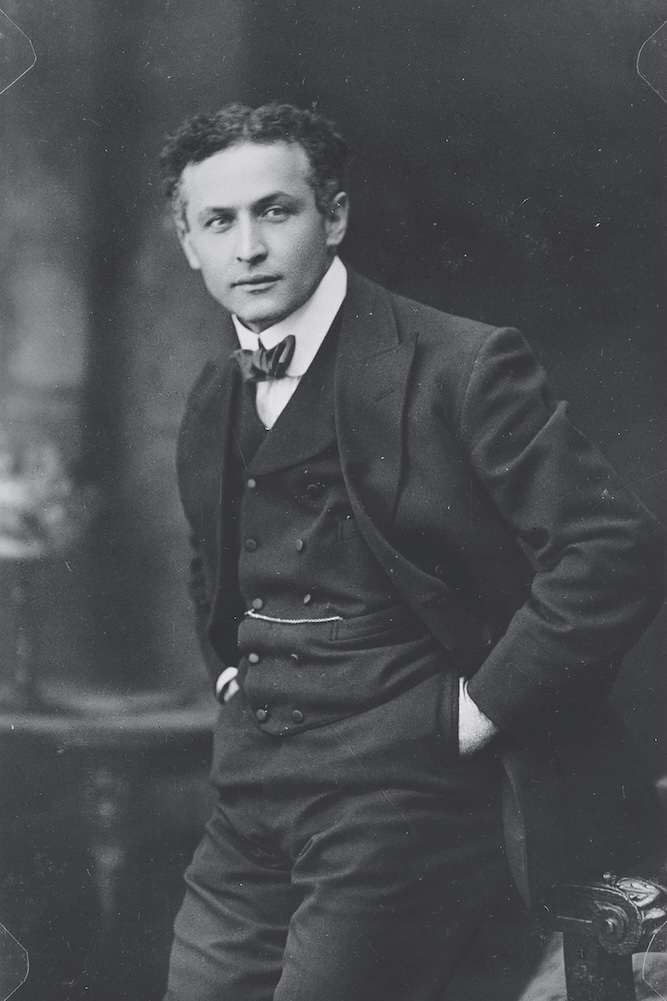
PHOTO: ADOBE STOCK
Harry Houdini was no stranger to Pittsburgh.
Between 1897 and 1925, he twice freed himself from restraints while suspended more than 80 feet above a Downtown street. He escaped boxes crafted and secured by expert packers from Kaufmann & Baer and Boggs & Buhl. He escaped submersion in an iron tank filled with Independent Brewing beer. He escaped our police force’s strongest “handcuffs,” Mayview’s most complex straightjackets, and even the waters of our rivers.
While the legacy of Houdini is most widely woven into feats of fearlessness, escape and illusion, he dedicated a not-insignificant portion of his career, and his visits to Pittsburgh, to exposing the fraud of Spiritualists — self-proclaimed mystics who insisted they possessed the power to access the spirit realm and the dead who occupied it.
Houdini had long made clear that he did not possess supernatural abilities, but rather utilized his mechanically minded intelligence to perform feats that only seemed otherworldly. He was so passionate about debunking Spiritualism that he wrote a book and dozens of articles exposing the tricks of its mediums. He testified at Congress against them. He hired a team of investigators who traveled the country attending seances in disguise to suss out the trickery used to generate apparitions and voices and to move objects. He then humiliated mediums by recreating their tricks onstage at his sold-out shows.
In the aftermath of World War I and the deadlier Spanish Flu pandemic of 1918, America was awash in loss and grief. As the Pittsburgh Post wrote in the preface to a 1919 weekly series exploring the resurgent interest in Spiritualism, “Empty chairs in the homes in countries recently engaged in the Great War have sent humanity groping to the Mystery of the Ages—the ways and means of communication with the dead.”
Spiritualism thus opportunistically moved further away from mere parlor tricks and increasingly toward religiosity. This model lent to the mediums a new veneer of authenticity. It was in Pittsburgh at their 1919 national convention that Spiritualists first defined their practice as “the Science, Philosophy and Religion of Continuous Life, based upon the demonstrated fact of communication by means of Mediumship, with those who live in the Spirit World.”
Journalists and politicians generally treated Spiritualism as a harmless practice worthy of mild ridicule at most, but to Harry Houdini, attaching the tricks of his trade to the mantle of science in order to perpetuate monetary fraud on the grieving was no laughing matter.
In 1907, Pittsburgh was home to about a dozen Spiritualist churches. By 1921, after the city lost 500 to the war, and another 5,000 to the pandemic, the number of these churches had more or less doubled. It’s natural for us to wonder how so many could have been fooled by simple tricks performed in dark rooms; it helps to understand that Houdini was able to legitimately astound and even frighten grown adults by performing that silly illusion your dad or grandpa did to make it appear as though he momentarily removed his thumb.
One nationally famous Spiritualist was Pittsburgh’s Rev. Cornelia V. Morrow, a matronly woman who, for 35 years, was pastor of the First Spiritualist Church across from Forbes Field. With her livelihood threatened by Houdini’s crusade, Morrow testified in support of Spiritualism at the same 1926 Congressional hearing as Houdini. During her remarks, she said to Houdini, “I have no malice in my heart toward you, and may God and the angels bless you if you are doing the right thing.”
As told by Houdini, walking back to her seat amid cheers from her supporters, she leaned over to whisper to him and his investigators, “Bunch of dirty little Jews.”
Houdini’s lead investigator, an intrepid young woman named Rose Mackenburg, told the Congressional subcommittee of a male Pittsburgh medium who used a dark seance room to make sexual advances, advising the disguised Mackenburg that her (non-existent) late husband was telling him from the afterworld that she must submit physically to the medium in order to receive her beloved’s message.
Determined to put such charlatans out of business, Houdini publicly offered a $10,000 cash prize to any medium who could perform a paranormal feat that he could not recreate by earthly means. Come 1925, with the prize yet unclaimed, Houdini issued challenges to Pittsburgh’s mediums prior to his February and September runs at the Davis and Alvin theaters, respectively.

PHOTO: ADOBE STOCK
His first challenge was broad, and no local medium reportedly came forward to accept it. In September, on what would be his final visit here, he issued a more specific challenge: correctly answer three questions written in sealed envelopes and go home with not only the standing $10,000 offer, but additional prizes from organizations like Scientific American, totaling $30,500.
The Rev. Dr. Alice S. Dooley, pastor of the Pittsburgh Church of the Divine Healing on the North Side, accepted the challenge and appeared onstage with Houdini at his Sept. 25 show. In front of a packed theater, Dooley’s answer to the first sealed envelope was, “All well and good, I see it is very possible, March 30, 1864.”
The question inside, as dramatically revealed by Houdini: “What was the name of the Hindu who taught me the East Indian trick?” Strike one.
Her response to the next sealed envelope was, “Is it possible?” Perhaps the mystic intended to be so ambiguous that she could massage her answer to at least partially fit the mold of the question.
Houdini then revealed the sealed query: “What chief of police from Pittsburgh did I meet in Europe?”
It was a humiliating strike two for Rev. Dooley. The spirits having seemingly failed to come to her aid twice, she declined to attempt the final answer.
With Dooley’s mystical inadequacies exposed, in the audience, one woman became “hysterical” and skirmishes soon broke out. That evening Dooley was reported to be “suffering from a nervous breakdown at her home.”
In addition to speaking to local groups and churches, and even KDKA Radio listeners, about fraudulent Spiritualists, Houdini authored articles for the Pittsburgh Press revealing their tricks and answered questions from Pittsburghers in a series he edited that ran during his September run.
One writer, Fred Voalked, insisted Houdini was in league with the devil because Voalked had once seen him make an elephant vanish live on stage. Houdini replied, “Everything I do can be explained by natural means and as to my being in league with the devil, no. That belongs to the dark ages.”
He reassured Dora Barton, who wrote that a medium said her infant was actually the reincarnated soul of her firstborn who died three years earlier, that yearning for the return of her lost child was understandable, but, “The little stranger you are now loving was given to you as an entirely different human and will grow up as such.”
Wilhelmina Braun wrote to ask Houdini why he kept “hounding the Spiritualists when you know they are consoling the bereaved?” He wrote movingly in reply, “It is far better to tell the bereaved immediately what is what, than let them chase a rainbow.”
Houdini died just a year later at the age of 52, not felled by a stunt gone wrong, but by disease. No medium ever was able to snag his $10,000 prize.
Instead, as respect for their religion began a long fade, the Spiritualists continued to try to dupe their marks. In 1931, Rev. Morrow assured readers of the Press that 1932 would be a wonderful year for the stock market, starting with a sustained upswing beginning in March.
As history tells us, it instead hit its basement that July.
Harry Houdini was a lot of things to history and to Pittsburgh. He was the Handcuff King. The Master Mysteriarch. The Self-Liberator. It is fitting that he is remembered for all he did on Earth that was seemingly made of magic, but let us not forget he also showed us that empathy can be magical, too.