Do You Speak Pittsburghese?
You won’t find another city that is so proud of its unusual accent and words — as well as its quirks.
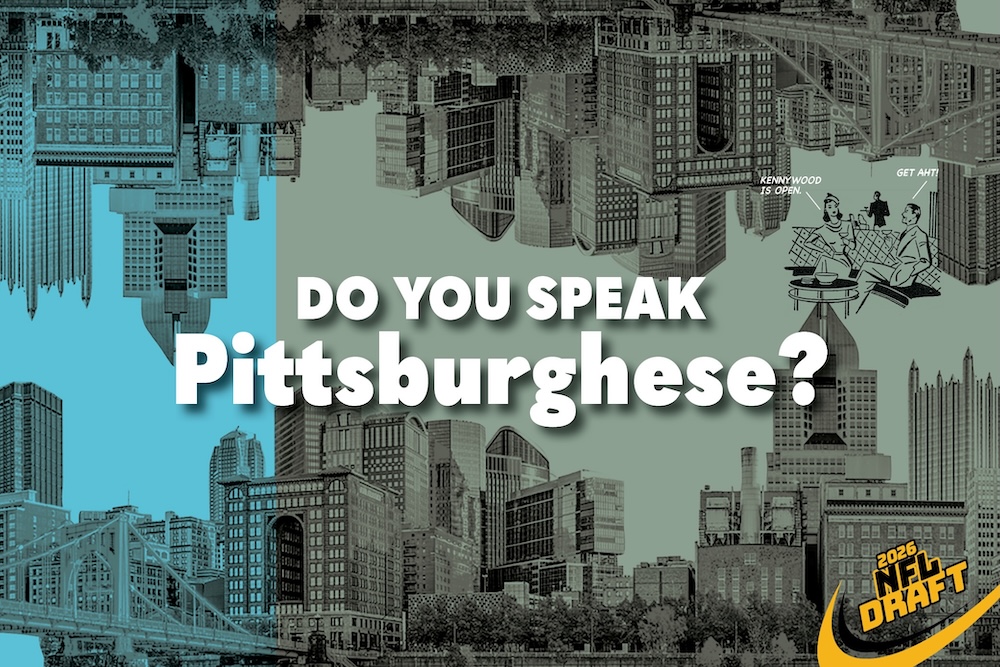
Pittsburgh has its own language and accent — it’s called Pittsburghese.
You go dahntahn, you worsh your clothes, you watch the Pittsburgh Stillers, winter sidewalks are slippy and redd up means to tidy up. The accent, in fact, was rated in 2020 as one of the least sexy accents by Big 7 Travel, coming in at No. 46 of a list of 50 cities or regions.
The foundation of the Pittsburgh accent and dialect is Scots-Irish, says Barbara Johnstone, professor emeritus of English and Linguistics at Carnegie Mellon University who has written extensively about Pittsburghese.
The Scots-Irish started arriving here from Ulster in the 1700s. Settlers directly from Ireland, then African Americans from the South (before the Great Migration) arrived in the mid-to-late 1800s to work in the steel mills and other industries.
Then between 1890 to 1920, there was a huge influx of immigrants from continental Europe: Italy, Greece and Eastern Europe. In actuality, however, the dialects and languages of these other newcomers had little influence on our Scots-Irish way of talking, she says.
While many features of the Pittsburgh accent actually stretch to other parts of Middle America, there are pronunciations of words like dahntahn (instead of downtown) and aht (instead of out), that are idiosyncratic to Pittsburgh, she says. “That is possibly the result of contact between the local way of talking and then some immigrant languages that didn’t have that sound and couldn’t pronounce it easily.”
Iron (as in Iron City Beer, a local specialty) sounds like arn, and Pittsburghers often drop the “to be,” as in “This needs fixed.” When you go shopping, you’re using a buggy instead of a cart.
“It is really interesting, and it’s unusual that Pittsburghese has gotten so tightly connected with the city’s identity. This doesn’t happen everywhere,” Johnstone says, noting that Philadelphia has a very distinctive accent, but there’s not this strong identity to that city like Pittsburghese has with the Steel City. “It’s gotten so connected with the identity of somebody who’s a real or authentic Pittsburgher.”
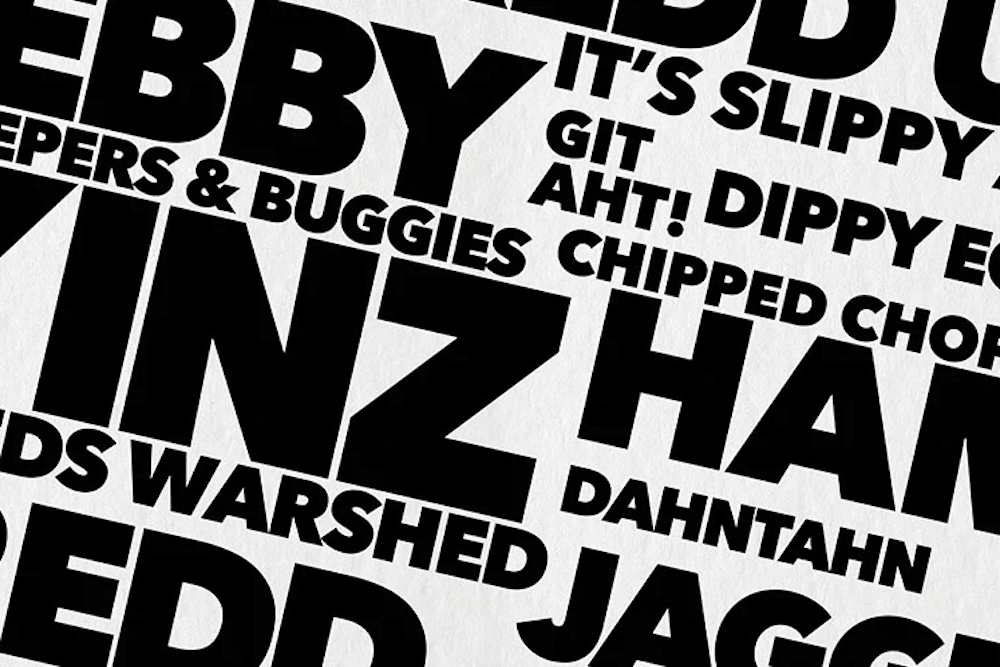
Here are some other terms and quirks you’re likely to encounter here (and see on T-shirts and mugs around town)
Nebby
Someone who is nosy, like a nebby neighbor.
N’at
A common term at the end of a sentence that means et cetera, or so forth. “We’re going Dahntahn, n’at.”
Gumband
A rubberband
Sammich
A sandwich
Don’t be a jagoff!
“A jagoff is someone who is a goof off, a dope, an idiot,” Johnstone says. It comes from the Scots-Irish meaning to poke, to needle someone, like a jaggerbush.
What’s a yinzer?
Pittsburghers fondly call themselves yinzers. Yinz is a contraction of “you ones,” Johnstone says. You’ll find the local Yinz coffee chain around town.
Don’t call it PIT
You may refer to Pittsburgh as the ’Burgh or shorten Pittsburgh to PGH in writing, but not PIT — ever (that’s reserved for Pittsburgh International Airport).
Pittsburgh with an H
Do not, under any circumstances, forget the “h” in Pittsburgh. We’re very proud of that h, which was briefly taken away from us in the late 1800s before being rightfully restored by the U.S. Board of Geographic Names in 1911.
Check your fly
If someone giggles and says “Kennywood is open,” check your pants. It means your zipper is down. Kennywood is the name of the popular amusement park south of Pittsburgh that’s been around for 128 years.
Why is there a chair in the street?
While this practice of saving a street parking space with a chair has been adopted by other parking-challenged cities, it’s a widespread practice here — especially after snowstorms when people have cleared spaces in front of their homes. It’s a major no-no to move someone’s parking chair to park in that space.
The Pittsburgh Left
This driving quirk might be popular elsewhere, but its name is connected with Pittsburgh. The Pittsburgh Left is when the stoplight changes to green and a driver quickly makes a left turn instead of waiting for the oncoming traffic to pass first.
Don’t slow dahn in the tunnel
This is a major pet peeve in Pittsburgh. There are four major tunnels entering the Dahntahn area — Fort Pitt Tunnel, Liberty Tunnel (or the “Liberty Tubes”), the Squirrel Hill Tunnel from the East and the Armstrong Tunnel entering Uptown. It’s human nature to slow down when entering a dark, narrow space, but many of these also follow complex merging configurations that add to the behavior.