Could Pittsburgh Get Its Own LEGO Set?
The set will be up for review in May, when a LEGO review board will make a “go/no go” decision on the product featuring notable Downtown architecture.
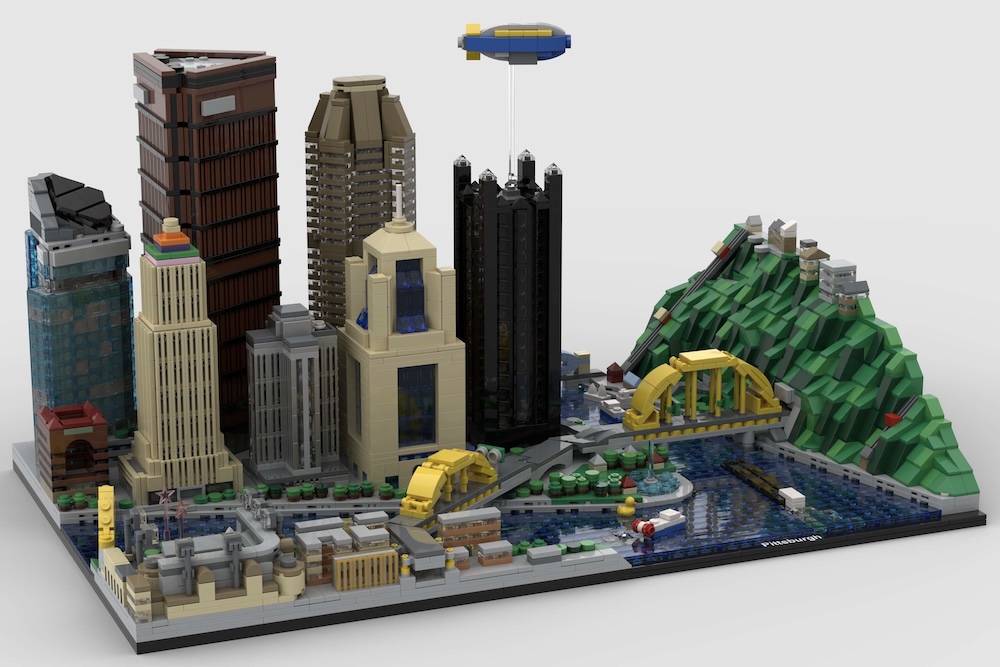
A MODEL OF MEYER’S PITTSBURGH LEGO SET USING BRICKLINK STUDIO | PHOTO COURTESY OF CHRISTIAN MEYER
A LEGO aficionado is hoping to bring the Steel City to store shelves.
Earlier this year, LEGO Ideas creator Christian Meyer, known online as Chris74, proposed a 1:1000 scale model of Pittsburgh through the LEGO Ideas program, a platform that allows builders to upload their own ideas for new sets, which are then supported by other users. If an idea receives 10,000 supporters within six months, the project can advance to the review stage, where a LEGO Ideas board will consider making it into an officially licensed LEGO set.
Meyer’s Pittsburgh proposal reached the milestone in less than two months. It’s something that the Dusseldorf, Germany resident says surprised him.
“To be quite honest, this came a bit unexpected. I had never really planned to submit the set to the LEGO Ideas website, but when it was ready, I thought that I could give it a try,” he says, adding that support was fueled mostly by social media at first, but that numbers “went through the roof” when his local news stations in Germany picked up the story. He was asked to give interviews on his local radio and TV stations, and he even came across a newspaper article about his project.
“So after I hadn’t really expected to reach 10,000 supporters, or at least not anytime soon, it ended up taking no more than two months to reach this milestone, and I’m still amazed and so thankful for all the feedback and support I have received,” he says.
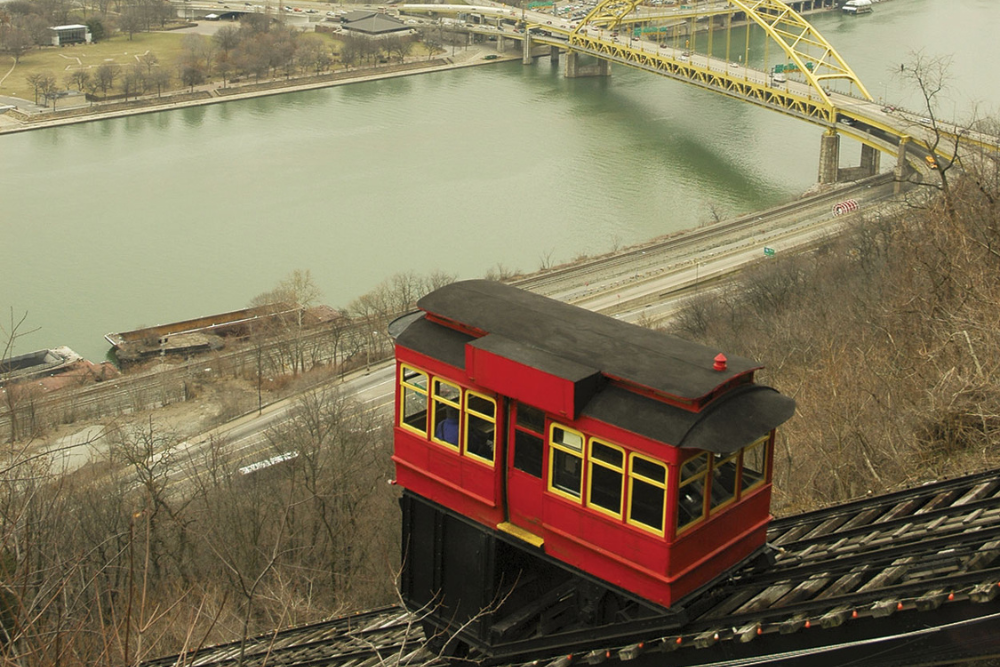
The model features a number of iconic buildings, including PPG Place, One Gateway Center, the U.S. Steel Tower, the Gulf Tower, the Tower at PNC Plaza, BNY Mellon Center and Fifth Avenue Place. It also highlights some of the city’s most famous icons: PNC Park, the Duquesne and Monongahela inclines, Point State Park, Gateway Clipper riverboats and even the infamous sinkhole bus.
In the model’s description, Meyer writes that he set out to “capture the spirit of this amazing city,” and that its architecture “tells the story of a city that transformed itself from a steel powerhouse into a modern center of technology, education and design.”
Choosing which elements to represent was no easy task, Meyer says, simply because there were so many things to choose from.
“Initially, I wanted to make this set roughly the size of the existing LEGO Architecture skyline sets, but I soon realized that this would be way too small for all the buildings and details that I considered a ‘must-have’ for the set. So the set became much bigger, but I still had to make some choices,” he says. “In the end, I went by which buildings felt most important and most recognizable to me personally. Some of them were no-brainers, like PPG Place, U.S. Steel tower, or 5th Avenue Place. Same for Point State Park and the bridges. Others, like the Tower at PNC Plaza or the Renaissance hotel, I have chosen because I personally liked the architecture.”
In a few cases, he adds, he had to exclude a building simply because it didn’t fit into the layout of the model, like Acrisure Stadium, or because he couldn’t find a good way to build it with existing LEGO pieces, one example being One Oxford Center.
“Other than that, I tried to include things that are typical for Pittsburgh in one way or another, also sometimes driven by my personal experience,” he says.
Some features, like the Monongahela Incline’s bridge across the street going up toward Mount Washington, were inspired by pictures by Dave DiCello, whom Meyer calls his “favorite Pittsburgh photographer.”
Even though Meyer is from Germany, his Pittsburgh connection dates back to the early aughts, when he visited the Steel City as part of his work as an IT consultant. He made several trips between 2003 and 2005 that left a lasting impression.
“That was the first time I have traveled outside of Europe, except for a short trip to Orlando in the early ‘90s, and I was absolutely impressed by the city, its architecture, its cultural and sports venues and the beautiful surrounding landscape,” Meyer says. “And I really liked the people that I met there and had a chance to spend time with. In a nutshell, to me, Pittsburgh was a great experience and a really good time.”
More recently, he has visited for leisure, and he continues to feel deeply connected to the city that has given him so many interesting and fun memories.

CHRISTIAN MEYER VISITING MOUNT WASHINGTON FROM GERMANY LAST SUMMER | PHOTO COURTESY OF CHRISTIAN MEYER
“Pittsburgh has just so many things to offer in terms of architecture and landscape that could be included in a LEGO model in some way,” he says. “As a big fan of the LEGO Architecture series, I always wanted to have a Pittsburgh set for my collection. And when I came across the Bricklink Studio software that lets you create your own custom LEGO models on a computer, it was an easy choice.”
Meyer says his history with LEGO is pretty standard; the bricks were one of his favorite toys as a child, but as he got older, his interest in them waned. Once his son was old enough to play with LEGO, the duo enjoyed building sets together. At some point, Meyer says, they started collecting Architecture sets as souvenirs from cities and places they had visited. If accepted, Meyer’s Pittsburgh would join the LEGOArchitecture roundup, which includes models of cities such as Paris, New York and London, as well as larger sets depicting architecture landmarks like the Trevi Fountain in Rome, Egypt’s Great Pyramid of Giza, New York’s Statue of Liberty and Himeji Castle in Japan.
According to LEGO’s website, the review phase can take a few months, and when finished, the LEGO Review Board will make a “go/no go” decision to develop and sell the LEGO product. The company’s decision is influenced by factors such as playability, safety and fit with the LEGO brand.
Meyer’s idea qualifies for the First 2026 Review in May. If given the green light, the project goes into the longest phase of the project: the development phase. During this time, LEGO model designers refine the product and develop it for release, creating the product materials and getting everything ready for a production run.
Updates will be posted on the project proposal page on LEGO’s website.